
 About Us
 Why K12?
 Safety Needs
 How Students Succeed
 FAQs
FAQs Online Elementary School
 Online Middle School
 Career and College Prep
 Online High School
 Student Clubs
 Career and College Services
 Inside the Online Classroom
 A Day in the Life
 Social & Extracurricular
 Advice, Tips & Inspiration
 Benefits for Life
 Enroll
 All School Options
 Need More Help?
Lock the Clock, Move the Class
The daylight saving debate misses one thing: dark school mornings. See what parents and teachers say, and the fix that isn't a new clock.
Table of Contents
The debate over daylight saving time keeps circling the same question: Should the country settle on permanent daylight time, permanent standard time, or keep springing forward and falling back? What’s often overlooked is how these time changes affect school mornings. So, we asked.
We surveyed 709 American parents of K–12 children and 305 K–12 teachers about how they weigh each option, then gave them a chart showing when the sun would rise in January in cities across the country under each option. We paired that with the bell schedules of the 100 largest U.S. school districts to count how many mornings kids would head to school in the dark under each policy. The parents and teachers we surveyed are not affiliated with K12.
In the end, people weren’t swayed by a different clock. They were convinced by the prospect of a more flexible start to the school day.
Three terms worth pinning down first: Permanent daylight saving time means staying on summer hours all year, with lighter evenings but darker winter mornings. Permanent standard time means staying on winter hours, with lighter mornings but earlier sunsets. Locking the clock means picking one of the two and ending the twice-a-year change. Throughout, a “dark commute” is a morning a student would leave for school — about 25 minutes before the first bell — before the sun is up; where we count the bell time alone, we say so.
Key Takeaways
- When parents see what permanent daylight saving time would actually mean for their kids, they change their minds. Support drops from 45% to 36% once they learn the sun wouldn’t rise until after 8 AM in most of the largest districts in January.
- Most parents won’t accept kids traveling to school in the dark. A majority (59%) won’t commit to locking the clock if it means their child heads to school before sunrise on winter mornings.
- Give them one flexible option and everything shifts. Most parents, 75%, would be comfortable with dark mornings if schools offered a later start or a virtual first period, with a 30-minute delay as the clear favorite.
- This is really a school schedule problem, not a clock problem. Under permanent daylight saving time, 94 of the 100 largest districts would start every winter morning with a before-sunrise commute, or 75 counting the first bell alone.
- The average Houston student would face about 145 dark commutes a year, more than any other metro. Across its nine largest districts, that adds up to roughly 110 million before-sunrise trips.
- Teachers are seeing it firsthand. 93% say students arrive tired on winter mornings, and 68% say a flexible start would help.
- Early bells are already a problem. 77% of parents say rigid start times clash with their child’s sleep, activities, or job.
What Permanent Daylight Saving Time Would Do to the Morning Commute
The clock the country picks decides how often kids head to school before the sun is up.
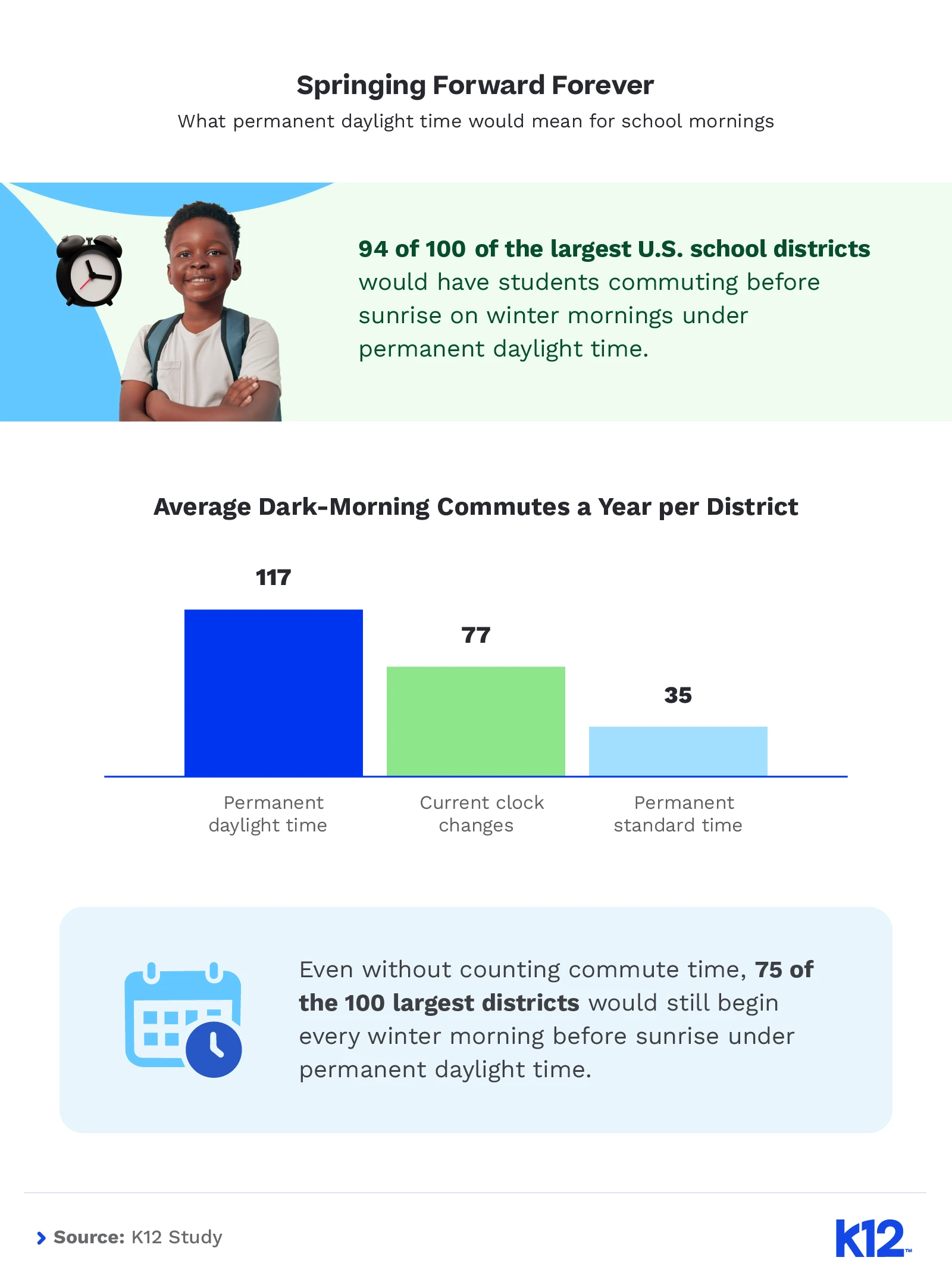
- Under permanent daylight saving time, 94 of the 100 largest school districts would start every winter morning with a before-sunrise commute. Counting the first bell alone, 75 of 100 still would.
- The average large district would face 117 dark commutes a year under permanent daylight saving time, more than triple the 35 it would see under permanent standard time. Today’s clock-changing schedule sits between them, at 77.
- Measured at the bell instead of the commute, permanent daylight saving time would still leave the average district dark on 82 mornings a year, compared with 22 under the current system and 7 under permanent standard time.
Where Dark Commutes Would Hit Hardest
Some metros would carry far more of that darkness than others.
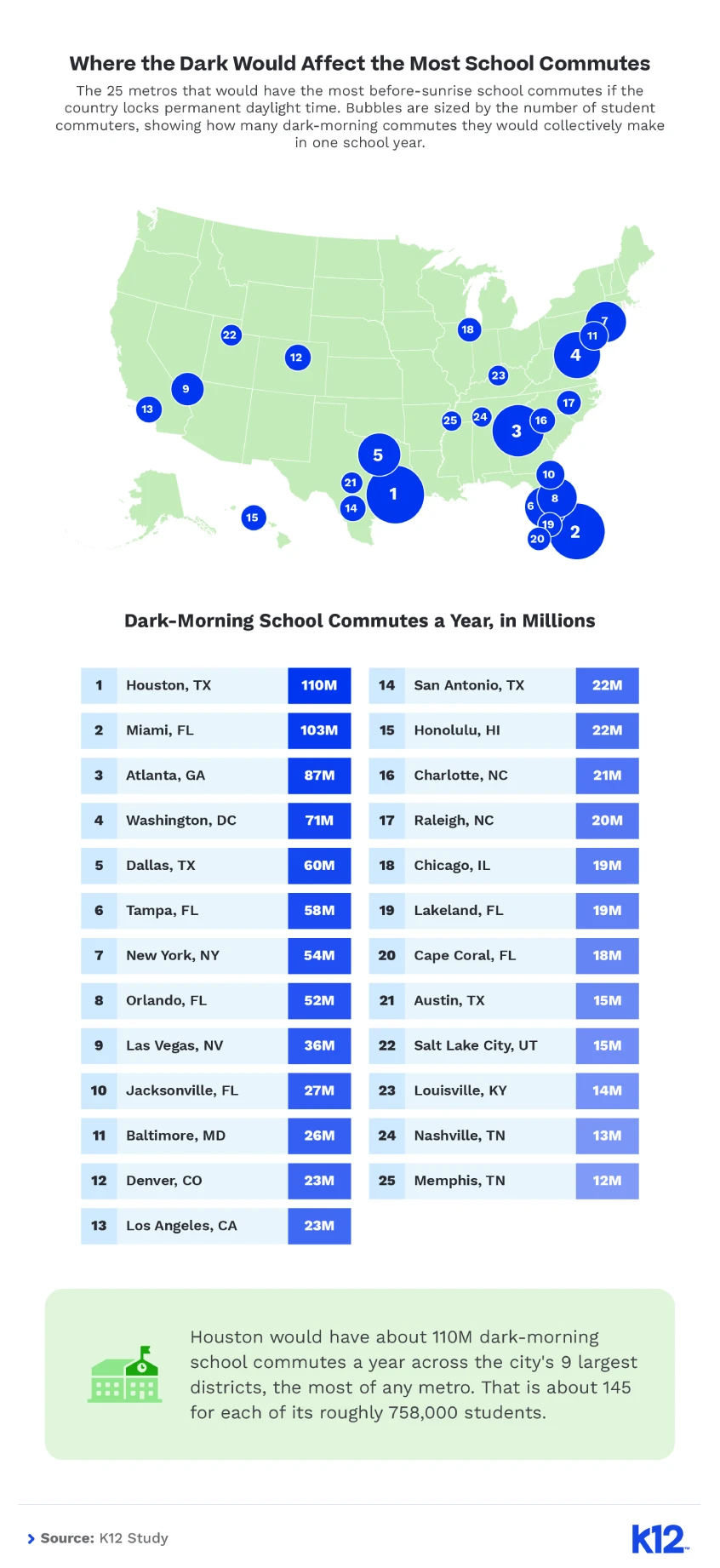
- The average Houston student would face about 145 dark-morning commutes a year, the most of any metro. Across its nine largest districts, that adds up to roughly 110 million before-sunrise trips.
- Miami (103 million) and Atlanta (87 million) came next, with Washington, D.C. (71 million) and Dallas (60 million) rounding out the top five.
- No California metro cracked the top 12. Los Angeles ranked highest at 13th because its high schools start at 8:30 AM or later.
- Among the 100 largest districts, the 15 most affected are all in Florida, Texas, or Georgia, and all start school by 7:25 AM. Lee County, Florida, ranks first, with 183 dark commutes out of 191 in-session mornings.
Why Parents Change Their Minds About Locking the Clock
When parents saw what permanent daylight saving time would actually look like, many reconsidered it.
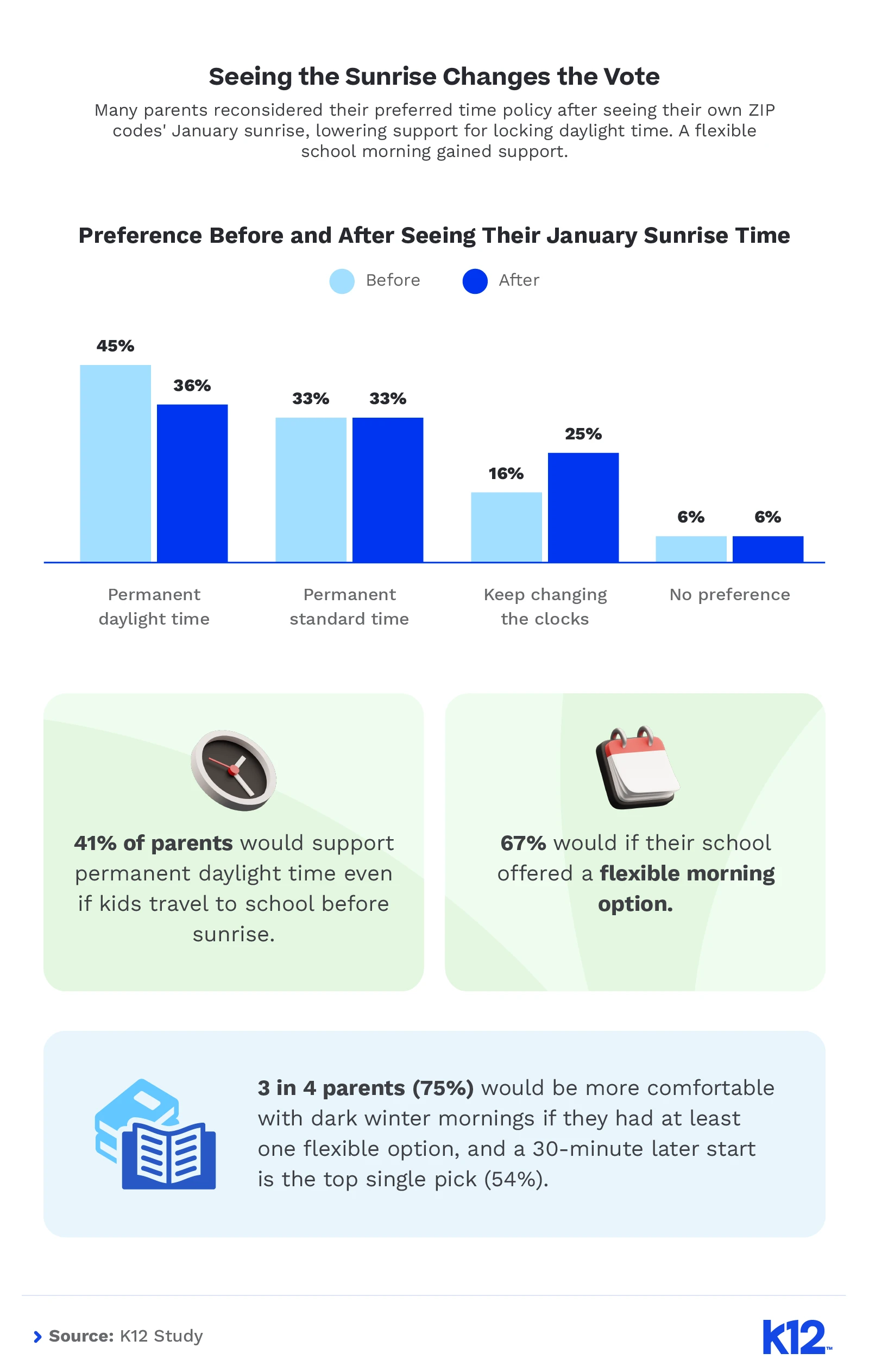
- Parents cooled their support for permanent daylight saving time after seeing how late January sunrises are. Support fell from 45% to 36%, and support for keeping the clock changes rose from 16% to 25%.
- About 2 in 5 parents (41%) would lock the clock through dark commutes as things stand today. If offered a flexible morning option of their choosing, 2 in 3 (67%) would.
- 3 in 4 parents (75%) would be more comfortable with dark winter mornings if they had at least one flexible option. A 30-minute-later start was the runaway favorite, chosen by more than half (54%) as their single top pick.
- Elementary school parents came around most readily: 3 in 4 (75%) supported a locked clock once a flexible option was on the table, compared with 65% of high school and 63% of middle school parents.
- 77% of parents say a rigid early start collides with at least one part of their child’s life, most often evening activities that end late (44%), trouble sleeping (37%), or a part-time job (10%).
What Teachers See on Dark Winter Mornings
Teachers who witness the impact of a dark first period back the same shift.
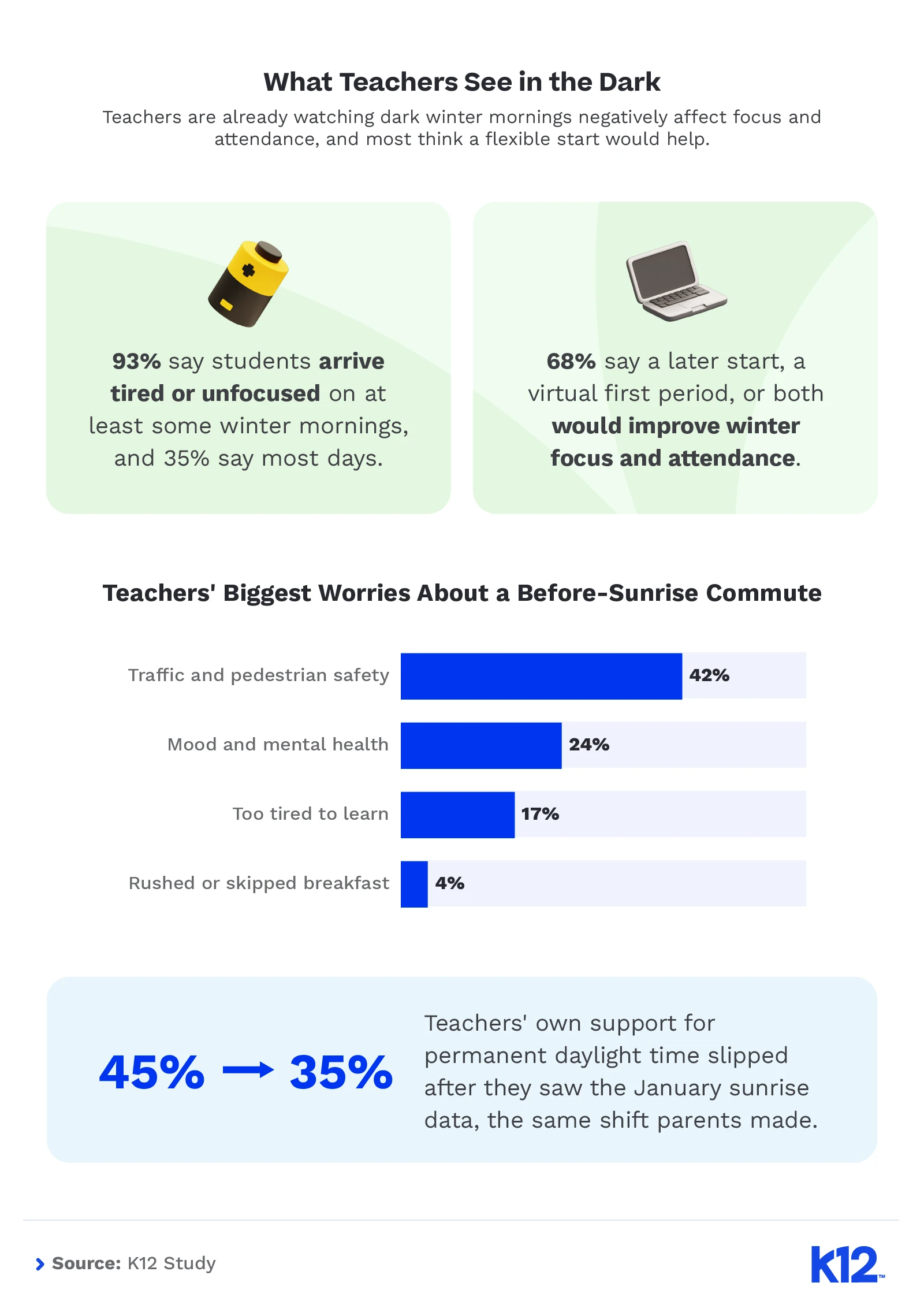
- More than 9 in 10 teachers (93%) say students arrive tired or unfocused on at least some winter mornings. Broken down, 58% say some days, 35% most days, 6% rarely, and 1% never.
- The toll increases with student age: 27% of elementary teachers report tired student arrivals on most days, rising to 44% among high school teachers reporting.
- More than 2 in 3 teachers (68%) say a later start, a virtual first period, or both would improve winter focus and attendance.
- Teachers’ support for permanent daylight saving time slipped from 45% to 35% after they saw the January sunrise data, mirroring the shift parents made.
The Fix Is the Classroom, Not the Clock
The daylight saving debate frames the morning as a choice between two clocks. The data points somewhere else. Whichever time the country settles on, the darkness lands on the commute, and the one change parents and teachers rallied behind was a more flexible school day start.
That’s where the school schedule matters more than the clock on the wall. A later start trims the dark commute, and a virtual first period removes it, because there’s no commute to make in the dark. For others seeking a flexible schedule beyond the morning commute, online schools may be worth a closer look, with no time change required.
Methodology
For the survey, we polled 709 American parents of K–12 children and 305 American K–12 teachers on August 17–19, 2026, to understand how families and educators weigh permanent daylight saving time, permanent standard time, and continued clock changes against the reality of dark winter commutes, and whether flexible school schedules change their views. Among parents, the average age was 42; 63% were women, 37% were men, and fewer than 1% identified another way. Generationally, 64% were Millennials, 30% were Gen X, and the remaining 6% were Gen Z or Baby Boomers. Among teachers, the average age was 42; 65% were women, 31% were men, and 4% identified another way or preferred not to say, spread across Millennials (49%), Gen X (26%), Gen Z (17%), and Baby Boomers (8%). Survey participants were not affiliated with K12.
The bell-schedule analysis covers the 100 largest U.S. public school districts by enrollment (NCES Common Core of Data). For each district, we computed local sunrise (NOAA Solar Calculator) for every in-session weekday of the 2025–2026 school year and compared it against the student’s departure, defined as the first bell minus a 25-minute commute buffer; a morning counts as dark when departure precedes sunrise, and every figure is also reported at a 0-minute buffer, which is simply the bell ringing before sunrise.
Counts run under three policies: the current clock-changing schedule, permanent standard time, and permanent daylight saving time (the House-passed Sunshine Protection Act). Metro and district commute totals multiply each district’s enrollment by its dark mornings and sum across a metro’s largest districts. Bell times come from official district calendars and bell-schedule pages, tagged “verified” where one start time applies districtwide or “representative” where schools vary within published windows.
Fair Use Statement
Content from this report may be shared for noncommercial purposes with proper attribution. Please include a link back to K12 when referencing or quoting any information.