
 About Us
 Why K12?
 Safety Needs
 How Students Succeed
 FAQs
FAQs Online Elementary School
 Online Middle School
 Career and College Prep
 Online High School
 Student Clubs
 Career and College Services
 Inside the Online Classroom
 A Day in the Life
 Social & Extracurricular
 Advice, Tips & Inspiration
 Benefits for Life
 Enroll
 All School Options
 Need More Help?
Better Schools, Bigger Bills: Why Online Public School Is Worth Exploring
Most families don't realize how much they're really paying for a good public school. See what the data says, and why online public school is worth a look.

Table of Contents
Where your child grows up often determines which schools they will attend, and some parents are making sacrifices to change that. We surveyed 660 parents of K–12 children who are not affiliated with K12 about the financial trade-offs they’ve made to access better public schools. We also analyzed home values and school achievement scores across all 50 states to show how much homes cost in top-rated school districts compared to the lowest-rated.
What we found might surprise you. Most families who moved made significant financial sacrifices to do it, and many are still feeling the cost. But moving isn’t the only option when high-quality online public schools are available across the U.S. For many families, online schools may be worth a closer look before deciding it’s time to start packing.
Key Takeaways
- 63% of parents have moved or seriously considered moving just to get their child into a better public school district.
- In 37 of 50 states, buying a home in a top-rated public school district now costs more per year than private school tuition for one child.
- Nationwide, a home in a top-rated public school district typically costs about 1.7 times as much as one in the lowest-rated, roughly $175,000 more.
- Among families who moved for a better school district, the most common sacrifices were paying higher rent or mortgage (46%), cutting back on vacations or spending (45%), and delaying a major purchase (36%).
- School-district premiums are steepest in California, New York, and North Carolina, where top-rated zone homes cost more than twice as much as the lowest-rated zone homes.
- School-district premiums are smallest in North Dakota, South Dakota, and Alaska, where top-rated and lowest-rated zones cost about the same.
What a Good School District Costs
For most families, the cost of a better school isn’t a tuition bill — it’s a mortgage. And depending on where you live, the price gap can be staggering.
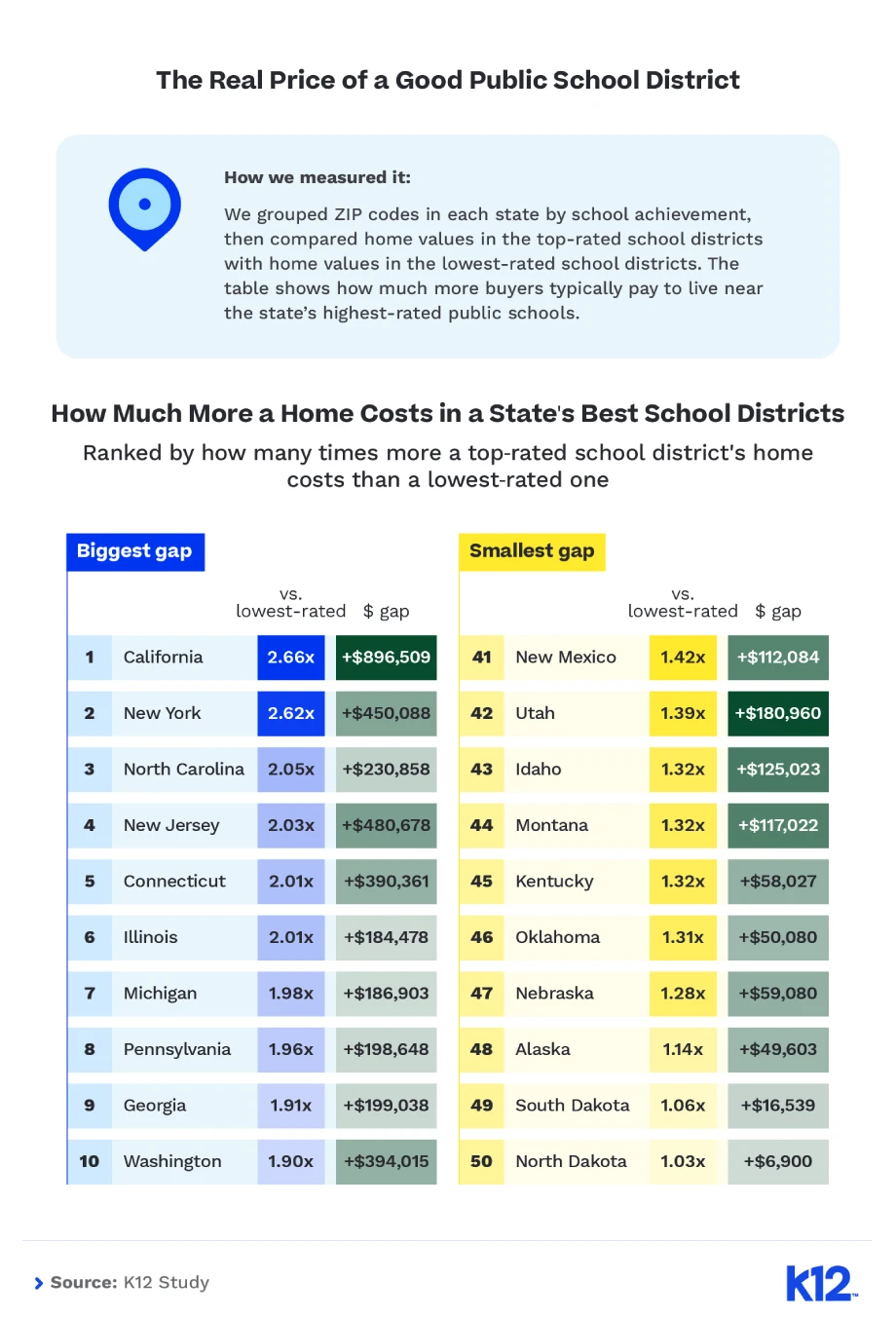
- California has the widest gap of any state. A home in its top-rated school district costs 2.66 times as much as one in the lowest-rated, a difference of $896,509.
- New York is the only other state where the premium exceeds two and a half times (2.62). New Jersey, Connecticut, Illinois, Michigan, and Pennsylvania all land near twice the price.
- The gap nearly vanishes in the Dakotas, where a home in a top-rated school district costs about the same as the lowest-rated (roughly 1.0 times as much), and school quality barely tracks with price.
- Nearly 3 in 4 states (74%, or 37 of 50) carry a school-district premium whose annual cost, financed over a 30-year mortgage, tops one child’s private tuition; in the typical state, that runs about $14,000 a year versus about $10,600 for private school.
What Moving for a Better School Costs
Moving to a better school district can come with a hefty cost, and for the families who pack up and go, the price tends to show up twice: once at closing, and again in the monthly budget for years afterward.
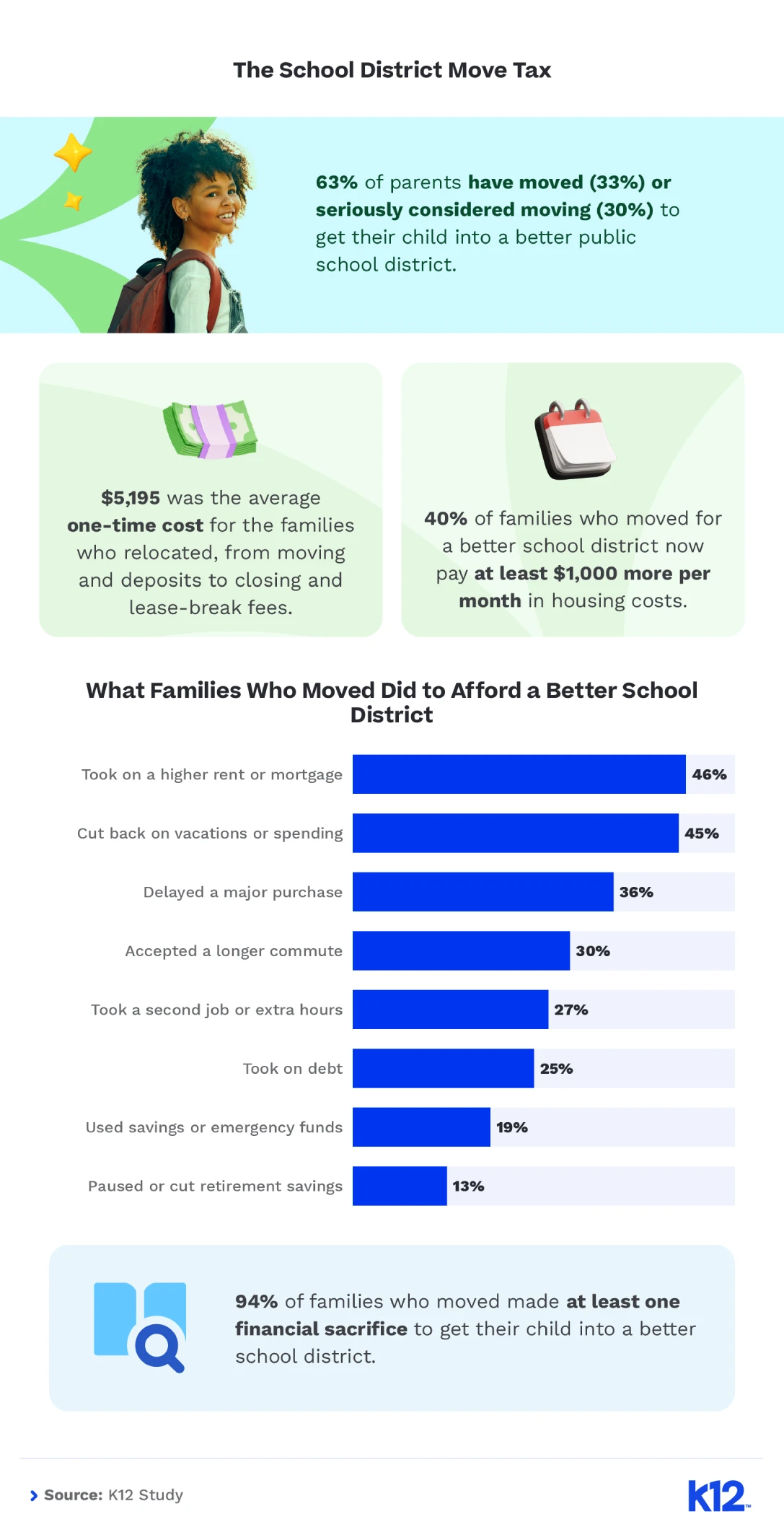
- Almost every family that relocated gave something up to do it: 94% made at least one financial sacrifice to afford a better school district.
- The move itself averaged $5,195 in one-time costs for families who relocated, including moving, deposits, closing, and lease-break fees.
- Among families who moved, 40% now pay at least $1,000 more per month in housing costs than they did at their old address.
- Gen X parents who moved spent more upfront than Millennials ($6,219 vs. $4,693) and pay more each month since moving ($840 vs. $642).
How Parents Feel About the Trade-Off
Once the move is behind them and the bills start to land, families are left to weigh whether the sacrifice paid off.

- More than 2 in 5 parents who moved (44%) said the cost of getting their child into a good school strained their family’s finances, compared with 1 in 8 parents who neither moved nor considered moving (13%).
- More than 9 in 10 parents agree that families with more money have better school options, a view shared by 91% of Millennial parents, 95% of Gen X parents, and even 88% of parents who neither moved nor considered moving.
- More than half of parents (55%) strongly agree, not just agree, that families with more money have much better school options.
Why Some Families Are Choosing Online Public Schools Instead of a Move
Choosing a school that’s right for your child doesn’t have to depend on your ZIP code or housing budget. Accredited tuition-free online public schools with high-quality curriculum, state-certified teachers, and a personalized approach to learning are available — regardless of where you call home.
These schools serve students across the U.S., from those living in rural communities to those in urban areas, advanced learners, students with special needs, traveling athletes, and military families who move frequently. Many families have discovered that finding the best educational fit for their child doesn’t require a big move — it can be available wherever they are.
Methodology
For the survey, we polled 660 American parents of K–12 children between June 10–11, 2026, to understand the financial sacrifices families make to access better school options, whether by moving into a preferred public school district or paying for private school. The average age was 42; 65% were women, 34% were men, and 1% identified another way or preferred not to say. Generationally, 65% were Millennials, 31% were Gen X, and the remaining 4% were Gen Z or Baby Boomers. Survey participants were not affiliated with K12. Dollar amounts are write-in responses, and reported averages exclude statistical outliers beyond 1.5 times the interquartile range; relocation-cost figures reflect the costs incurred by families who moved.
The housing analysis pairs Zillow Home Value Index data by ZIP code (typical-value tier, April 2026) with school-achievement data from the Stanford Education Data Archive (SEDA 2025.1, NAEP-linked, math and reading, grades 3 to 8, pooled tested years 2009 to 2025), linked to ZIP codes through the NCES Common Core of Data school directory (2018). Within each state, ZIP codes were ranked by enrollment-weighted achievement and split into a top third and a bottom third; the school-zone premium is the difference in average home value between them, reported as both a dollar gap and a multiple. Annual comparisons finance the one-time premium over a 30-year mortgage at 7%. Private school tuition reflects 2025 state averages from College Transitions. All 50 states were measured at ZIP grain, except Vermont, which was measured at county grain because a post-2018 school-ID reorganization prevents reliable ZIP-level linkage.
Fair Use Statement
Content from this report may be shared for noncommercial purposes with proper attribution. Please include a link back to K12 when referencing or quoting any information.