
 About Us
 Why K12?
 Safety Needs
 How Students Succeed
 FAQs
FAQs Online Elementary School
 Online Middle School
 Career and College Prep
 Online High School
 Student Clubs
 Career and College Services
 Inside the Online Classroom
 A Day in the Life
 Social & Extracurricular
 Advice, Tips & Inspiration
 Benefits for Life
 Enroll
 All School Options
 Need More Help?
What Is the Midyear Online School Enrollment Process for Parents?
Learn about the midyear online school enrollment process, including steps, timelines, required documents, and tips to avoid delays.

Table of Contents
The midyear online school enrollment process typically involves several steps, including:
- Researching schools
- Submitting an application
- Providing required documents
- Withdrawing from your current school
- Completing enrollment approval
Many online schools offer rolling enrollment, allowing families to begin the process at any time of the year.
If you’re thinking about switching your child to online school midyear, you’re probably wondering what the enrollment process actually looks like. The good news is that it’s more straightforward than many parents expect. While there are several steps involved, each one is manageable when you know what to expect.
This guide walks you through the complete enrollment timeline, from your first research call to your child’s first day of online classes, so you can plan ahead and avoid common delays.
Can I Enroll My Child in Online School Midyear?
Yes, many online schools offer rolling enrollment, allowing families to apply and start at different points throughout the year. While some programs have preferred start dates, many accommodate midyear transfers when students need a change.
Step 1: Research and Contact Schools
What to Look For
Start by confirming your child is eligible for the schools you’re considering. Public online schools typically serve specific geographic areas, so verify residency requirements first. Check accreditation status to ensure credits will transfer if your child switches schools again. Review curriculum offerings to confirm they match your child’s academic needs and interests.
Questions to Ask Admissions
When speaking with enrollment specialists, ask about midyear start dates and course availability. Find out how credits will transfer from your child’s current school. Ask what technology your family needs to provide versus what the school supplies. Clarify the Learning Coach role and time commitment expected from parents.
Step 2: Gather Your Documents
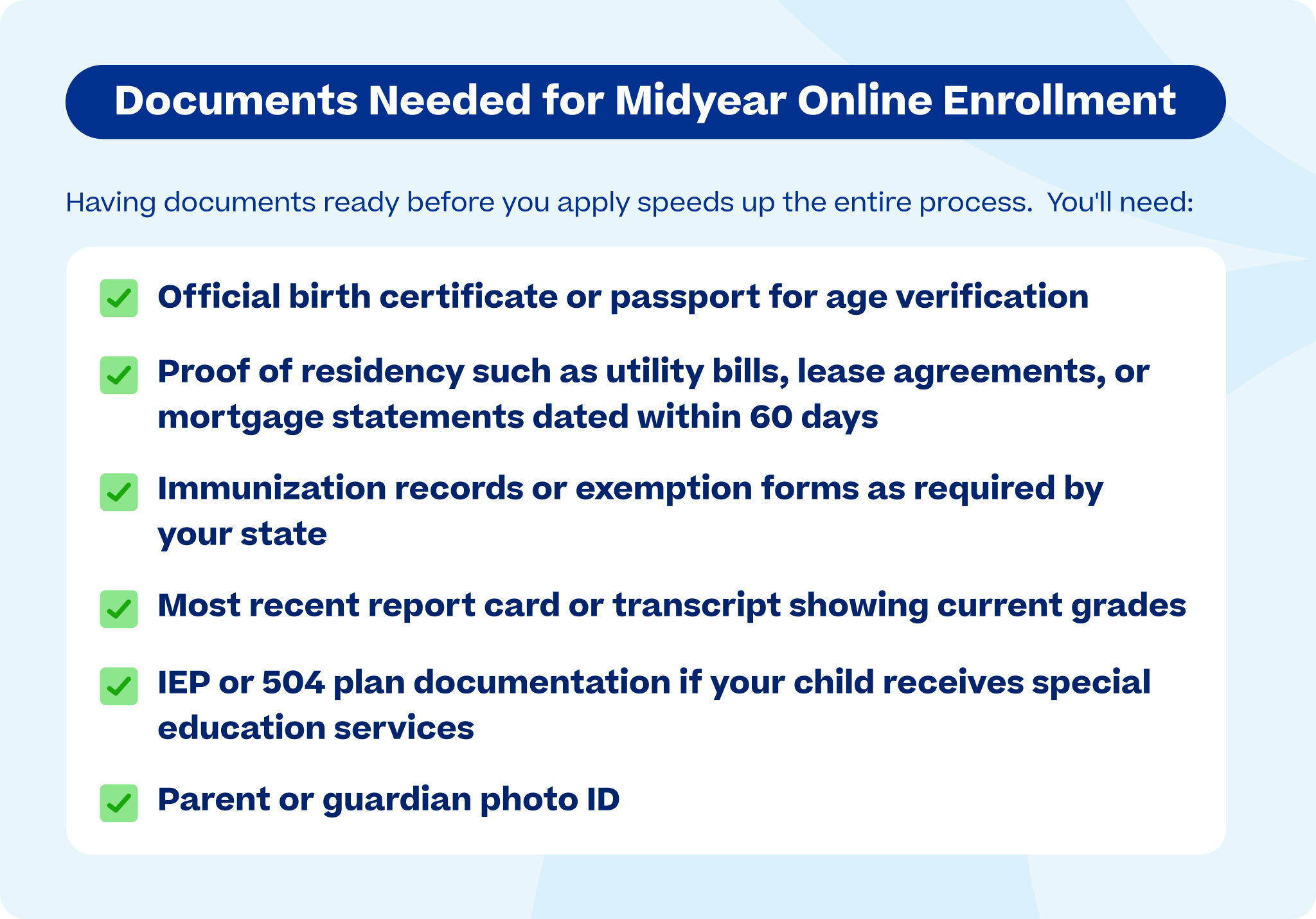
Having documents ready before you apply speeds up the entire process. You’ll need:
- Official birth certificate or passport for age verification
- Proof of residency such as utility bills, lease agreements, or mortgage statements dated within 60 days
- Immunization records or exemption forms as required by your state
- Most recent report card or transcript showing current grades
- IEP or 504 plan documentation if your child receives special education services
- Parent or guardian photo ID
Requirements vary by state and school type. Public schools typically require proof you live in their service area, while private online schools may have more geographic flexibility. Contact your chosen school’s enrollment team to confirm exactly what you need.
This is one of the most important steps in the enrollment process. Completing this early can help prevent delays later.
Step 3: Submit Your Application
Most online schools offer digital enrollment portals where you create an account, complete household and student information forms, and upload required documents. The application itself typically takes 1 to 3 hours to complete. Schools usually review applications within one business day and contact you if additional information is needed.
After submission, follow up within 24 to 48 hours to confirm your documents were received and ask about the review timeline. This keeps your application moving forward and helps identify any issues early.
Step 4: Request Transcripts From the Current School
Request official transcripts from your child’s current school as soon as you decide to transfer. This step often causes the biggest delays because previous schools can take 1 to 3 weeks to process transcript requests, especially during busy periods like semester breaks.
For midyear transfers, the new school needs to evaluate which credits from the current semester will transfer and how to place your child in appropriate coursework. Providing complete records upfront shortens this review. If transcripts are delayed, contact your previous school’s registrar directly to check on the request status. Many online schools will accept unofficial transcripts temporarily while official ones are processed.
Step 5: Complete Placement Assessments
Some schools conduct placement assessments to ensure your child is matched with appropriate coursework. This is especially important for midyear transfers or students with gaps in their academic history. These assessments help schools determine where your child should start in each subject, ensuring they’re neither overwhelmed nor under-challenged.
Assessments are typically completed online and take 1 to 2 hours. Schools provide instructions and technical support to make the process smooth.
Step 6: Attend Orientation and Set Up Technology
After acceptance, you’ll attend orientation sessions where you learn to navigate the online learning platform, understand attendance requirements, and establish daily routines.
Orientation typically happens within 1 to 2 weeks of acceptance. Many schools offer separate sessions for parents and students, and share tools and support to make your child’s transition much smoother.
During this phase, you’ll also receive login credentials, meet your child’s academic advisor, and complete technology checks to ensure your devices and internet connection meet requirements. Learning materials and textbooks are usually delivered within 1 to 2 weeks.
The Complete Enrollment Timeline
Understanding the full timeline helps you plan your child’s transition. Here are a few things to keep in mind as you begin exploring the online school enrollment process:
- Research and school selection typically take 1 to 2 weeks. During this phase, take time to compare curriculum offerings, verify accreditation status, and check state residency requirements. According to the U.S. Department of Education’s National Center for Education Statistics, understanding school choice options and enrollment policies helps families make informed decisions about their child’s education.
- Application submission takes 1 to 3 days when documents are prepared in advance. Most schools review applications within one business day to verify completeness.
- Document verification varies based on complexity. Standard enrollments with straightforward transcripts take a few business days to one week. Complex situations involving out-of-state records or homeschool documentation may take 2 to 3 weeks.
- Acceptance to the first day takes 2 to 4 weeks. During this period, your child receives course assignments, meets their academic advisor, and gets learning materials delivered. Orientation sessions help families learn about the online platform and establish daily routines.
Understanding the timeline at each phase in this enrollment process will help your child switch to online school with ease.
Common Pitfalls and How to Avoid Them
Knowing what can go wrong helps you avoid unnecessary delays:
- Delayed transcripts: Request them immediately when you decide to transfer, not when you submit your application
- Residency verification issues: If utility bills aren’t in your name, ask the enrollment team what alternative documentation they accept
- Incomplete documents: Provide official certified birth certificates, not hospital-issued ones, and ensure immunization records are current
- Poor timing on withdrawal: Wait for official enrollment confirmation before withdrawing your child from their current school to avoid gaps in services
- Lack of communication: Respond promptly to enrollment team emails and calls, and don’t hesitate to ask questions
Taking Your First Steps Forward
The online school enrollment process involves multiple steps, but each one is manageable when you understand what to expect. Most families complete enrollment in 2 to 4 weeks, with the timeline largely depending on how quickly you gather documents and request transcripts. The key to a smooth process is early preparation and proactive communication with enrollment specialists.
Remember that enrollment teams are there to guide you through every stage. If your child needs a change, don’t wait for the perfect timing.
Understanding the process is the first step. Now make sure you’re prepared. See the requirements to transfer to online school midyear.