
 About Us
 Why K12?
 Safety Needs
 How Students Succeed
 FAQs
FAQs Online Elementary School
 Online Middle School
 Career and College Prep
 Online High School
 Student Clubs
 Career and College Services
 Inside the Online Classroom
 A Day in the Life
 Social & Extracurricular
 Advice, Tips & Inspiration
 Benefits for Life
 Enroll
 All School Options
 Need More Help?
More Families Opting for a “Compromise Summer” in 2026
The Compromise Summer is here. See how 63% of parents are trading the big family trip for something closer to home, and why their kids might prefer it.

Table of Contents
The school year is winding down, and roughly 10 weeks of summer break are about to land in parents’ laps. That stretch is its own kind of math problem: childcare to figure out, learning loss to manage, kids who need a break, kids who need stimulation, and a calendar that has to hold it all without breaking the family budget.
This year, more parents are solving that problem with a compromise. We surveyed 1,022 American parents (not affiliated with K12) and analyzed Google search trends across 50 major U.S. metros to find out what summer break actually looks like in 2026. The data points to a clear shift: the big family trip is losing its grip, and a new kind of summer is taking its place. We’re calling it the Compromise Summer, when families consciously trade the postcard-worthy vacation for something quieter, closer to home, and easier on the credit card. 63% of parents told us this summer isn’t the one they wanted, it’s the one they could afford. That’s not a small group. That’s the new majority.
Key Takeaways
- One in four American parents is planning to skip the big trip this summer, either as a pure staycation (15%) or with no specific travel plans (10%).
- Searches for “staycation ideas” jumped 76% year over year nationwide, led by Philadelphia (+300%), Miami and Atlanta (+233% each), and Houston (+220%).
- Nearly half of parents (46%) have gone into debt or overspent on credit to pay for a family summer vacation, with Gen X leading every generation at 51%.
- 39% of Gen Z parents admit they’ve made their summer plans sound bigger or more exciting than they really are, nearly double the rate of Millennial parents (21%) and Gen X parents (19%).
- 30% of parents who took a big family summer trip say their kids didn’t actually enjoy it.
What’s Driving a Compromise Summer
Behind many postcard-worthy vacations is a credit card bill, and parents are starting to talk about it.
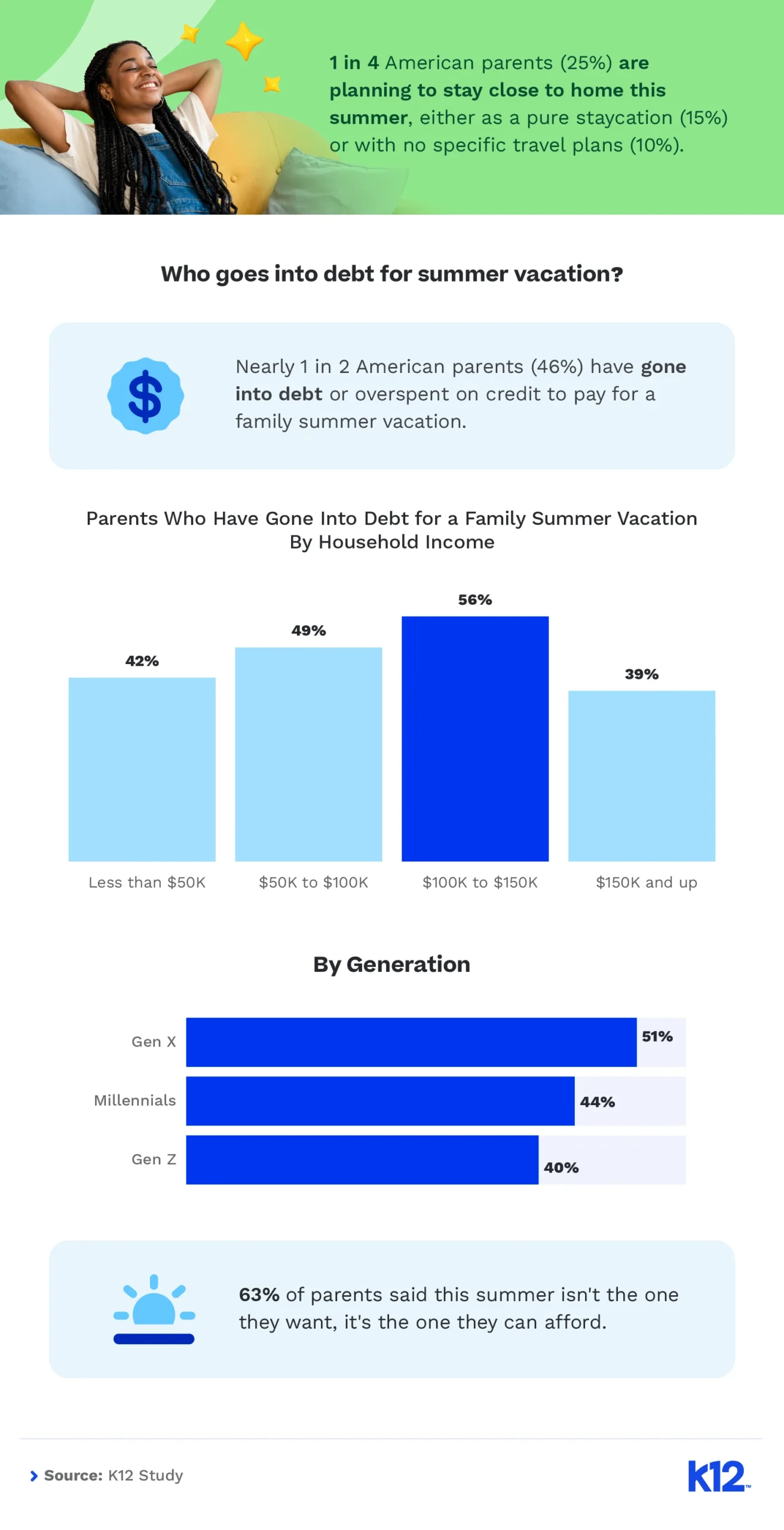
Close to half of parents surveyed (46%) have taken on debt or charged more than they could afford on credit cards to fund a family summer vacation.
- The pattern peaked in middle-income households earning $100K to $150K, where 56% carried summer debt.
- Households earning $50K to $100K followed at 49%.
- Lower-income households earning less than $50K (42%) and upper-income households earning $150K and up (39%) reported lower rates.
- Gen X parents reported the highest debt rate at 51%, followed by Millennials (44%) and Gen Z (40%).
Average planned spending nearly tripled across income brackets, from about $1,750 for parents earning less than $50K to about $5,050 for parents earning $150K and up.
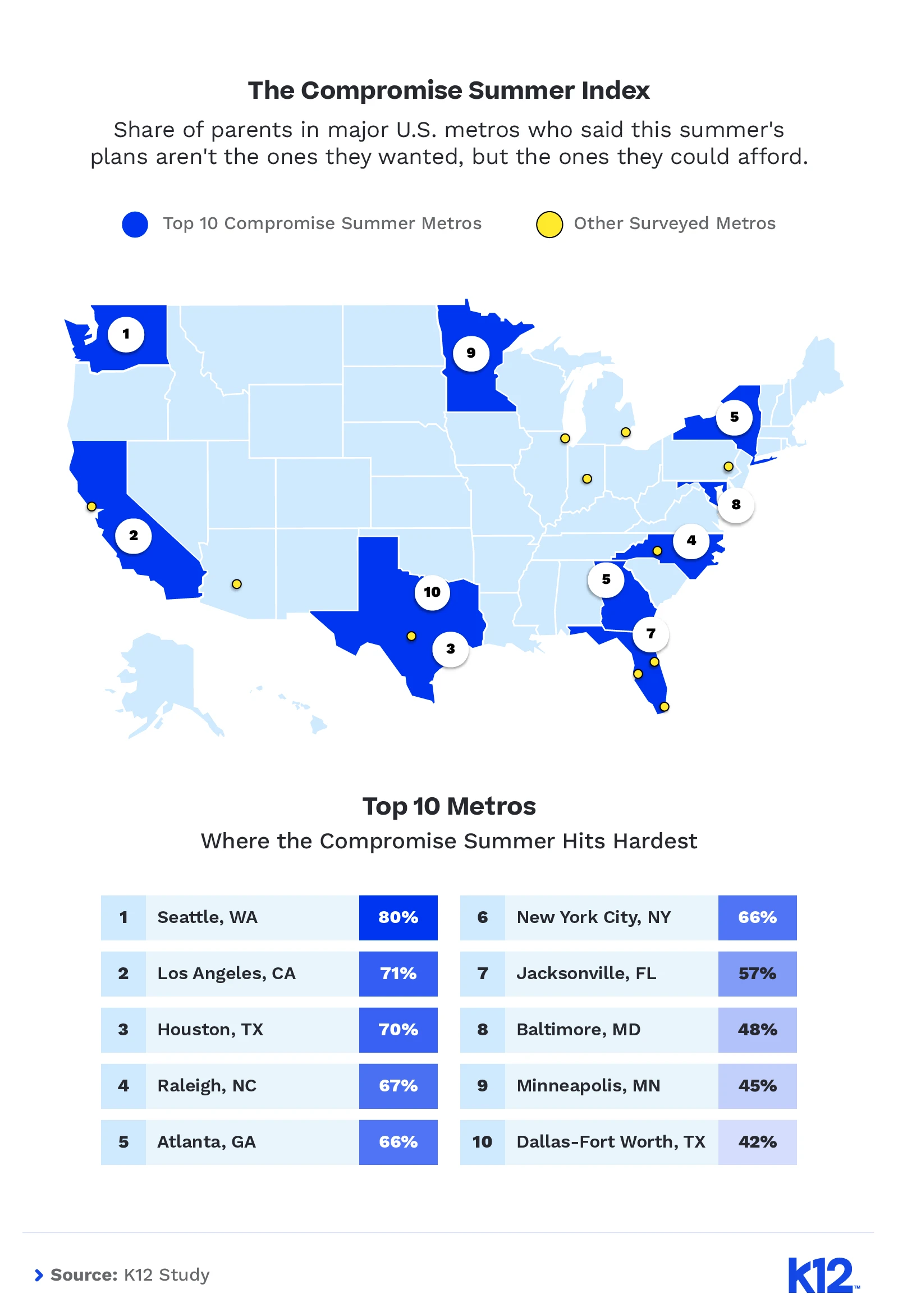
This is the financial pressure underneath the Compromise Summer. Roughly two in three parents (63%) said their plans for summer break aren’t what they would like to experience, but they’re what they can afford. 70% of parents earning less than $50K called this summer a compromise, as did 53% of parents earning $150K and up.
Guilt is part of the equation too: 72% of parents said they feel bad that their summer plans aren’t big or exciting enough. More than three-quarters of single-income households (76%) and 68% of dual-income households said they feel that guilt at least sometimes.
Overall, 25% of parents said their families are planning a staycation this summer or not traveling. The shift away from the big trip is showing up most strongly in:
- Dallas–Fort Worth (42%)
- Detroit (36%)
- Houston (35%)
- Atlanta (32%)
- Indianapolis (31%)
- Seattle (30%)
- Phoenix and Orlando (28% each)
- Los Angeles (25%)
- Chicago (24%)
The Pressure to Plan the Perfect Summer Break
Even as the Compromise Summer takes hold, parents still feel the pull to make summer break feel special. With school out, parents want to get summer right, delivering memorable experiences, keeping kids happy, and making the most of the season.
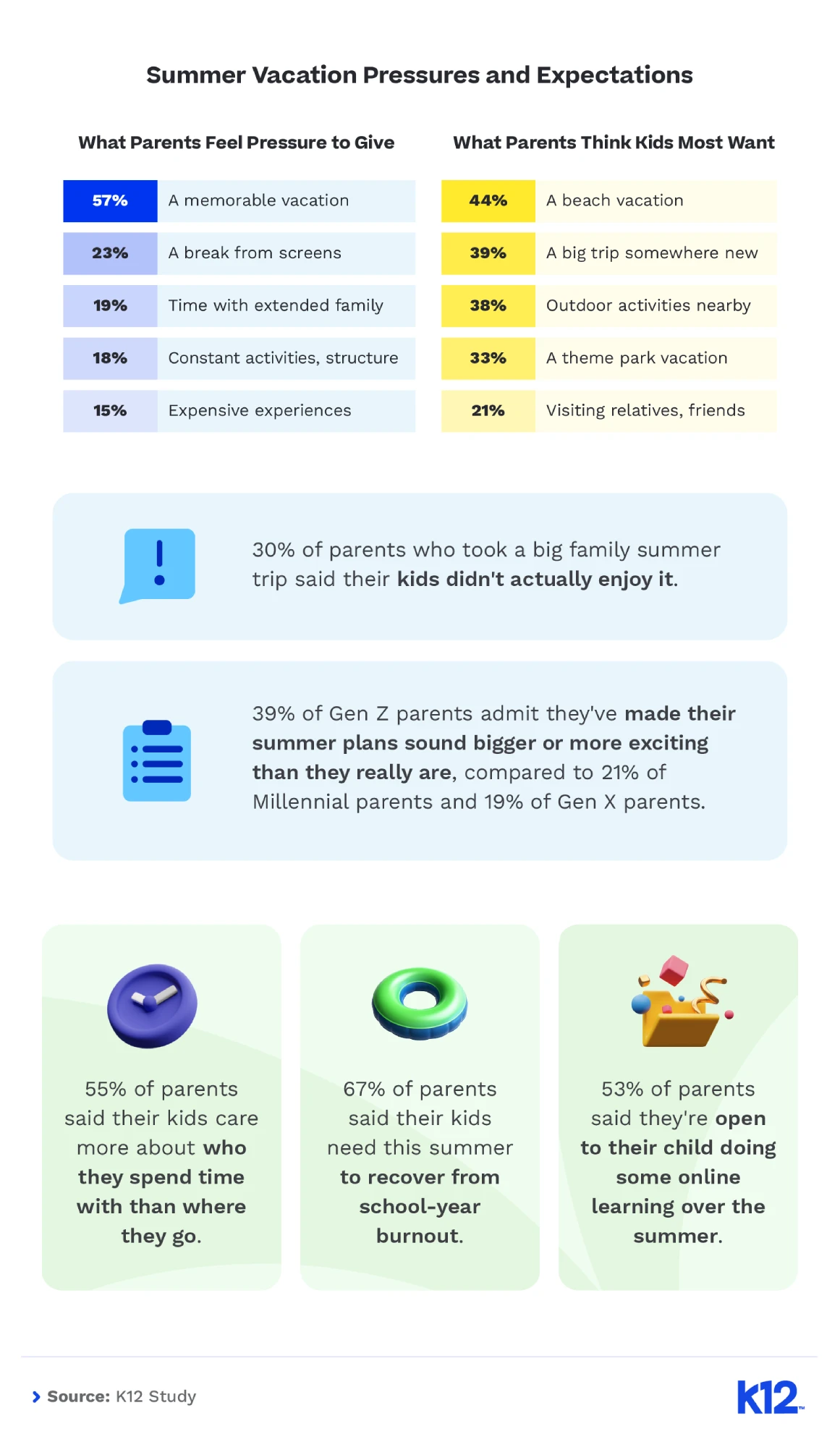
When asked what they feel pressure to provide, parents most often said a memorable vacation (57%), a break from screens (23%), and time with extended family (19%). When asked what they think their kids most want, the answers shifted.
Parents said kids most often want a beach vacation (44%), a big trip somewhere new (39%), or outdoor activities nearby (38%). Most parents reported getting it right, but 30% who took a big family summer trip said their kids didn’t actually enjoy it.
That gap is part of why a Compromise Summer can land better than expected. 55% of parents said their kids care more about who they spend time with than where they go, and 67% said their kids need this summer to recover from school-year burnout.
Parents Face Social Pressure, While Students Recover From Burnout
The Compromise Summer doesn’t always land easily. Social pressure plays a part in how parents feel about scaling back. Nearly half of Gen Z parents (45%) said social media makes their family’s summer feel not enough, compared with 41% of Millennials and just 36% of Gen X parents.
Pressure from other parents follows a similar pattern: 40% of Gen Z parents, 32% of Millennials, and 29% of Gen X parents say they feel it. And the temptation to inflate the story is real: 39% of Gen Z parents, 21% of Millennials, and 19% of Gen X admitted they’ve made their plans sound bigger or more exciting than they really were.
Burnout is also shaping the conversation, especially as kids get older. Nearly three in four high school parents (73%) said their kids need this summer to recover, compared with fewer elementary school parents (63%). For these families, the Compromise Summer isn’t a downgrade; it’s exactly what their kids need.
What a Compromise Summer Actually Looks Like
The Compromise Summer is making a comeback in two forms: pure staycations and budget-friendly local plans that still feel like a real summer break. Nearly two in three parents (64%) agreed that a good staycation can feel just as special as a big vacation. This climbed to 74% among Gen Z parents but dropped to 57% for Gen X parents.
When asked what local options would feel just as special as a vacation, parents pointed to:
- Pool or beach days close to home (43%)
- Day trips to nearby attractions (42%)
- Summer festivals and concerts (34%)
- Local amusement or water parks (32%)
Who’s Behind the Compromise Summer
Search behavior tells the same story as the survey. Families aren’t just talking about staying home this summer break, they’re planning for it.
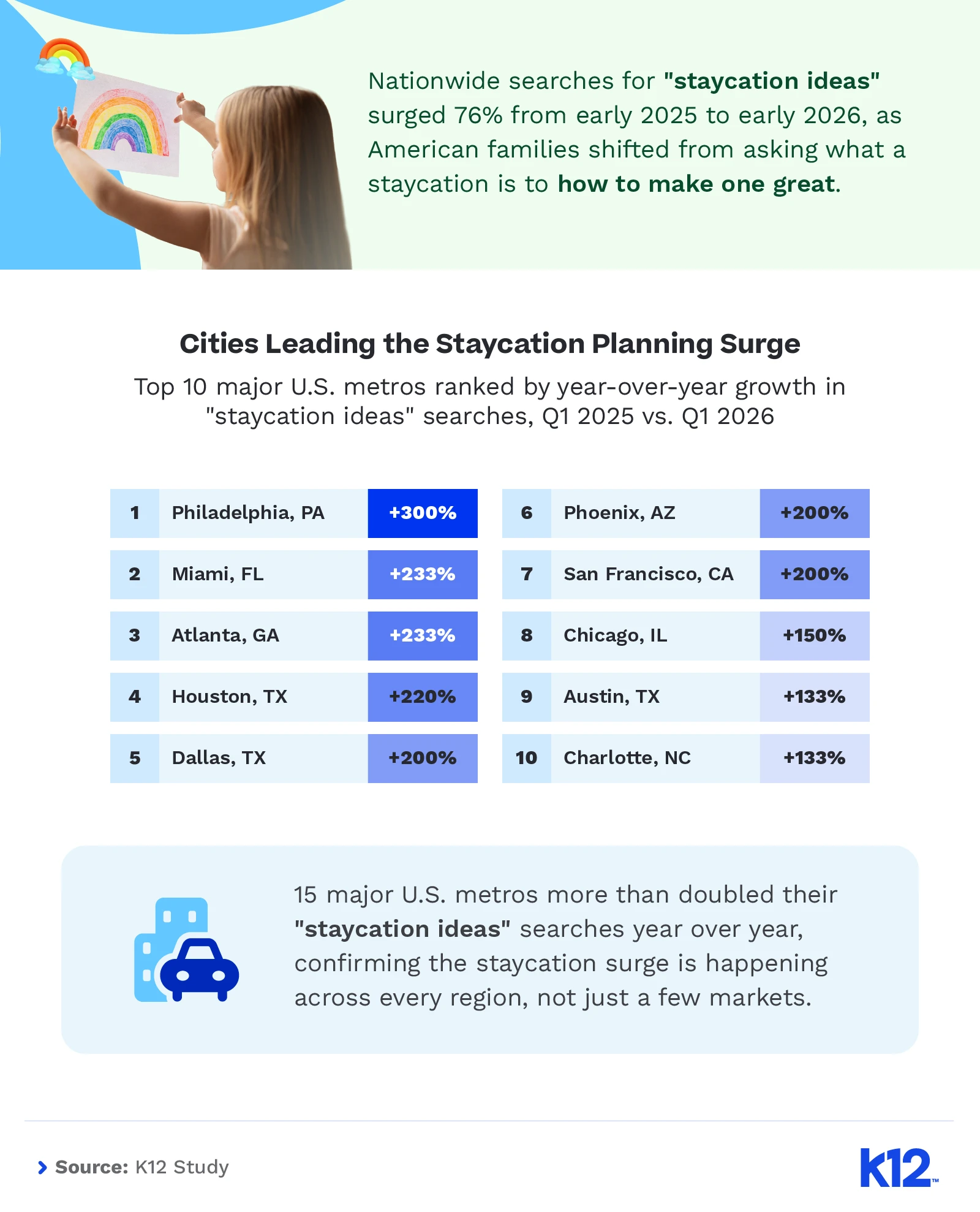
Nationwide searches for “staycation ideas” surged 76% year over year, while searches for the generic term “staycation” alone fell 16%. The drop in the broader term suggests the concept is now familiar, and families are searching for the how-to rather than the what. Fifteen major U.S. metros saw “staycation ideas” searches more than double over the same period.
The income split is sharp. More than one in three parents earning less than $50K (34%) are planning a pure staycation or keeping a regular summer routine, compared with just 16% of parents earning $150K and up.
But satisfaction with the staycation choice is nearly universal across generations: 79% of Gen Z parents, 76% of Millennial parents, and 71% of Gen X parents who have staycationed in the past said they were satisfied with the experience.
Summer Learning Plans Are Part of the Compromise
For a lot of these families, the Compromise Summer also means leaning into structured learning at home. More than four in five elementary school parents (81%) said they’re planning at least one educational activity this summer, as do 75% of middle school parents and 61% of high school parents.
Concern about academic skill loss tracks with school stage in an interesting way. Middle school parents are the most worried, with 44% at least somewhat concerned about summer skill loss. A smaller but still significant number of elementary school parents (35%) and high school parents (25%) said the same.
The Compromise Summer City by City
The national numbers tell one story, but the regional data tell a more textured one. Some metros are leading the financial pressure. Others are leading the search surge. A few are doing both. This index measures the share of parents who said this summer’s plans aren’t the ones they wanted, but the ones they could afford.
- Atlanta, GA: 66% of Atlanta parents said this summer is a compromise. Atlanta also more than tripled its “staycation ideas” searches year over year (+233%).
- Austin, TX: Austin parents more than doubled their “staycation ideas” searches year over year (+133%).
- Baltimore, MD: 62% of Baltimore parents said they would personally prefer a staycation this year over a big trip, the highest preference rate of any major U.S. metro. More than three in four (76%) also said their kids care more about who they spend time with than where they go.
- Charlotte, NC: 76% of Charlotte parents said their kids care more about who they spend time with than where they go, tied for the highest rate among major U.S. metros. Charlotte also saw more than double the year-over-year growth in “staycation ideas” searches (+133%).
- Chicago, IL: 40% of Chicago parents often or always feel guilty that their summer plans aren’t big or exciting enough. Chicago’s “staycation ideas” searches also surged 150% year over year.
- Dallas–Fort Worth, TX: 42% of DFW parents are planning a staycation or have no specific summer plans, the highest rate among major U.S. metros. DFW “staycation ideas” searches tripled year over year (+200%), and 74% said a good staycation can feel just as special as a big vacation. DFW parents also planned the lowest summer spend in the country at about $1,600 per family.
- Detroit, MI: 36% of Detroit parents said a past big family summer trip wasn’t actually enjoyed by their kids, the second-highest rate of any major U.S. metro, and 77% agreed a good staycation can feel just as special as a big vacation.
- Houston, TX: 70% of Houston parents said this summer is a compromise, the third-highest rate among major U.S. metros. Houston led all U.S. metros in raw “staycation ideas” search volume in 2026 (+220% year over year).
- Indianapolis, IN: 65% of Indianapolis parents said their kids care more about who they spend time with than where they go, and 31% are planning to stay close to home this summer. Indianapolis also doubled its “staycation ideas” searches year over year (+100%).
- Jacksonville, FL: 57% of Jacksonville parents have gone into debt or overspent on credit for a family summer vacation. Nearly two in five (39%) often or always feel guilty that their summer plans aren’t big enough, and 48% said they would personally prefer a staycation this year.
- Los Angeles, CA: 71% of LA parents said this summer is a compromise, the second-highest rate among major U.S. metros. LA families reported among the highest summer spending in the country at about $3,285 per family, yet 47% have gone into debt for a summer vacation.
- Miami, FL: Miami parents more than tripled their “staycation ideas” searches year over year (+233%).
- Minneapolis–St. Paul, MN: Minneapolis–St. Paul parents planned the highest summer spending of any major U.S. metro at about $4,110 per family. More than 1 in 2 (57%) have still gone into debt for a summer vacation.
- New York City, NY: 66% of NYC parents said this summer is a compromise, and 49% have gone into debt for a summer vacation. Nearly two in three (63%) said their kids care more about who they spend time with than where they go.
- Orlando, FL: 78% of Orlando parents said a good staycation can feel just as special as a big vacation, the highest rate among major U.S. metros. Nearly half (47%) said they would personally prefer a staycation this year.
- Philadelphia, PA: Philadelphia led every major U.S. metro in “staycation ideas” search growth, up 300% year over year. More than half of Philadelphia parents (55%) have also gone into debt for a family summer vacation.
- Phoenix, AZ: 62% of Phoenix parents have gone into debt for a family summer vacation, the highest debt rate of any major U.S. metro, and 41% have gone into debt more than once. Phoenix “staycation ideas” searches also tripled year over year (+200%).
- Raleigh, NC: 67% of Raleigh parents said this summer is a compromise, and 71% also agreed that a good staycation can feel just as special as a big vacation.
- San Francisco, CA: San Francisco parents tripled their “staycation ideas” searches year over year (+200%).
- Seattle, WA: 80% of Seattle parents said this summer is a compromise, the highest rate of any major U.S. metro. Three in five (60%) have gone into debt for a summer vacation, and 50% said a past big family summer trip wasn’t actually enjoyed by their kids, both national highs.
- Tampa Bay, FL: Tampa Bay parents planned among the highest summer spends in the country at about $3,380 per family, yet 50% said they would personally prefer a staycation this year.
The takeaway across regions is the same. Families are looking harder at what they’re spending, what their kids actually enjoy, and whether the big trip is worth the bill that follows.
The Compromise Summer doesn’t have to mean a smaller summer. The kids who say they care more about who they’re with than where they go are telling parents something useful, and the search data backs them up. Families aren’t giving up on summer break. They’re rewriting what those 10 weeks are supposed to look like, and a backyard sprinkler counts.
Methodology
This survey included 1,022 American parents with children in kindergarten through 12th grade. Respondents were not affiliated with K12. The survey explored how families are planning their 2026 summer vacations, how rising costs are reshaping those plans, how often parents feel guilty or pressured about summer expectations, how kids’ actual preferences compare to what parents think they want, and how American families are redefining what a successful summer looks like. Parents were also asked about their generation, household income, household type, their child’s grade level, and the metropolitan market. The metropolitan markets sampled align with the Axios Local network, enabling regional and local analysis across major U.S. metros.
Among respondents, 72% identified as women, 27% as men, and 1% as nonbinary or preferred not to say. Generationally, 3% were Baby Boomers, 32% were Gen X, 58% were Millennials, and 8% were Gen Z. Regarding their children’s grade level, 45% had children in elementary school (kindergarten through 5th grade), 20% in middle school (6th through 8th grade), and 35% in high school (9th through 12th grade).
The study also analyzed Google search-volume data across 50 major U.S. metropolitan markets from January 2025 through March 2026 for staycation-related keywords, including both general terms and planning-intent terms: “staycation,” “staycation ideas,” “cheap summer vacation,” “summer activities near me,” and “day trips near me.” Year-over-year comparisons focused on first-quarter (January through March) search volume to capture early summer planning behavior.
Percentages have been rounded to the nearest whole number, so some totals may not sum to 100%. Demographic findings are reported only for subgroups representing at least 5% of the total survey sample. Data was collected in early 2026.
Fair Use Statement
The information in this article may be used for noncommercial purposes only. If shared or referenced, proper attribution with a link back to K12 must be included.