
 About Us
 Why K12?
 Safety Needs
 How Students Succeed
 FAQs
FAQs Online Elementary School
 Online Middle School
 Career and College Prep
 Online High School
 Student Clubs
 Career and College Services
 Inside the Online Classroom
 A Day in the Life
 Social & Extracurricular
 Advice, Tips & Inspiration
 Benefits for Life
 Enroll
 All School Options
 Need More Help?
For generations, snow days meant sledding, snowball fights, and a surprise break from routine. But they also meant disruption and the potential delay of summer vacation. As online learning becomes more common, some districts have started swapping a day off for a virtual learning day. But how do parents feel about this change? And should snow days be completely replaced by online learning?
To understand how parents feel about modern snow days and how many school districts are switching to online learning during inclement weather, we analyzed state-level virtual learning policies. We surveyed 1,004 parents nationwide (not affiliated with K12). The results reveal a tug-of-war between the traditional snow day and modern alternatives, as well as a need to give children time to enjoy the snow without disrupting their studies.
Key Takeaways
- Nearly three in four parents (74%) say snow days are an important part of childhood.
- 83% of parents agree children need unstructured breaks for mental health, and 75% say kids today have fewer opportunities to just “be kids.”
- 61% of parents refuse to trade snow days for a longer summer, and 67% refuse to trade snow days for non-snow weather closures.
- Still, more than 1 in 2 parents (52%) want virtual learning in place for some or all snow days.
- 86% of parents believe there should be some limit on traditional snow days.
Snow Days Then and Now: A Changing Tradition
For parents who grew up waking to school closure announcements on the radio or TV, snow days hold a special place in memory. Today’s children experience snow days differently, but parents overwhelmingly agree these moments still matter.
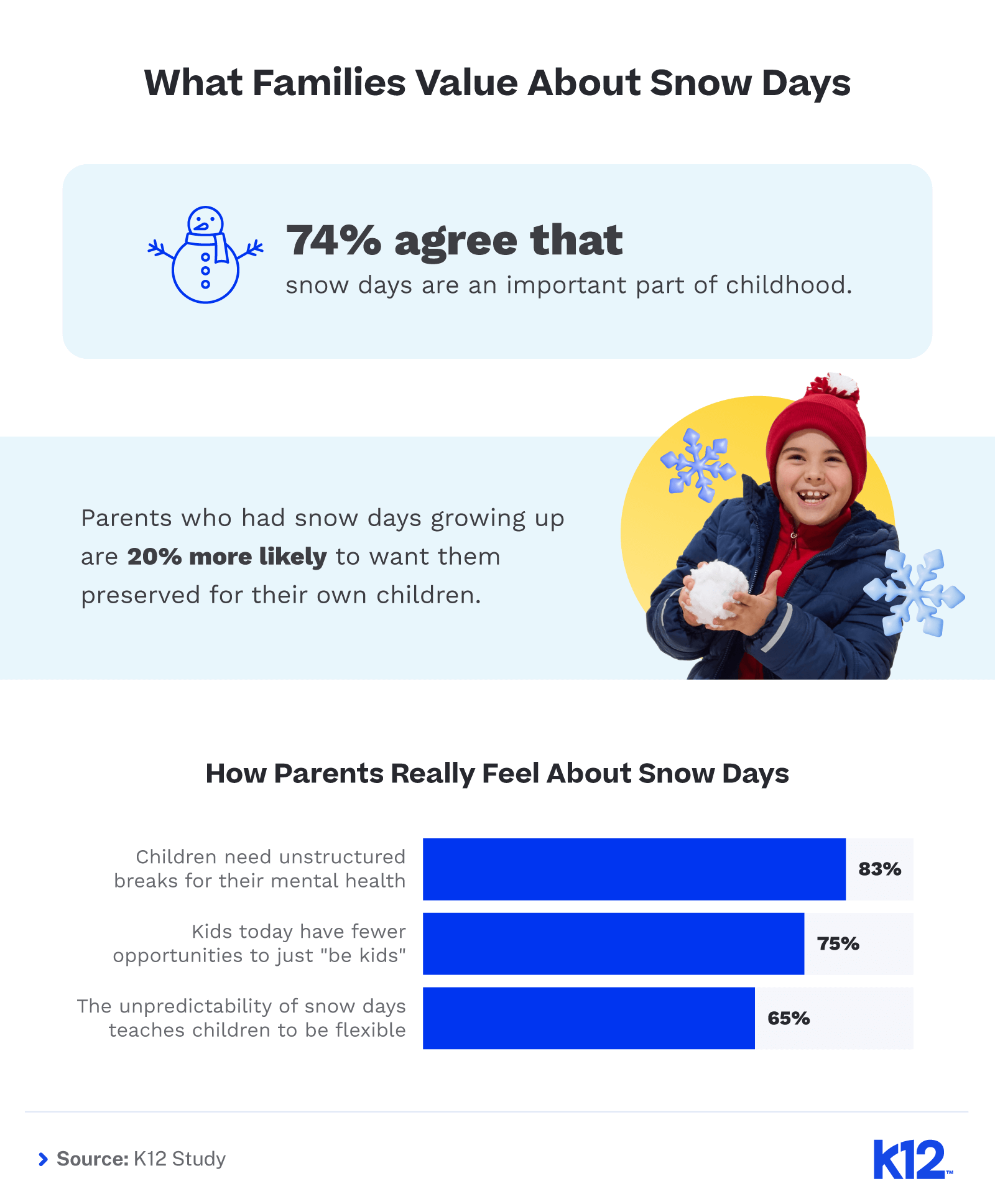
- 74% of parents agree that traditional snow days are an important part of childhood.
- 83% agree that children need unstructured breaks from school for their mental health and well-being.
- 75% say kids today have fewer opportunities to just “be kids” than previous generations.
- 65% agree that the unpredictability of snow days teaches children to be flexible.
- Parents who had snow days growing up are 20% more likely to want them preserved for their own children.
The Role of Online Learning: Creating Flexibility for Families and Schools
As technology expands access to online education, state policies are shaping whether snow days stick around or shift to screens.
Here’s a breakdown of how remote learning policies can look across the U.S.:
- District discretion or unspecified policy: Districts can decide when to do remote learning for inclement weather, or don’t appear to have a specific policy declaring a maximum of remote learning days
- Limits the number of remote days that can count: Requires schools to make up any additional inclement-weather days. Limits are typically three to five days, but they can reach 10 in several states, including Virginia and Kentucky.
- Prohibits remote learning from counting toward instructional requirements: This means make-up days are required if weather closures drop a district below the minimum.
- 20 states allow district discretion for remote learning during inclement weather (primarily states that don’t experience heavy snow).
- 27 states limit how many remote days can count, requiring schools to make up additional inclement weather days.
- Three states and Washington, D.C., prohibit counting remote learning toward instructional time.
These policies are being put to the test this winter as severe weather impacts many parts of the U.S. Most notably:
- The Southeast has been hit the hardest (relative to normal), with many districts facing school closures from 7 to more than 12 days. Schools in Memphis were forced to close for 9 consecutive days, burning through their 8 built-in weather days. Nashville burned through their 6 built-in weather days, and many schools even lost power. Both storms (Winter Storm Fern from January 23–27 and the storm on February 1) also closed schools in Northern Mississippi and North Carolina, as well as major universities throughout the region.
- The Northeast and Mid-Atlantic regions have experienced 3-5 school closure days (and counting) this year, with the massive February 23 storm still affecting schools. New York City schools had their first school closure in 7 years. Philadelphia schools, having burned their built-in snow days in January, have begun virtual learning.
- The Midwest region saw school closures in waves, including those caused by the back-to-back January storms.
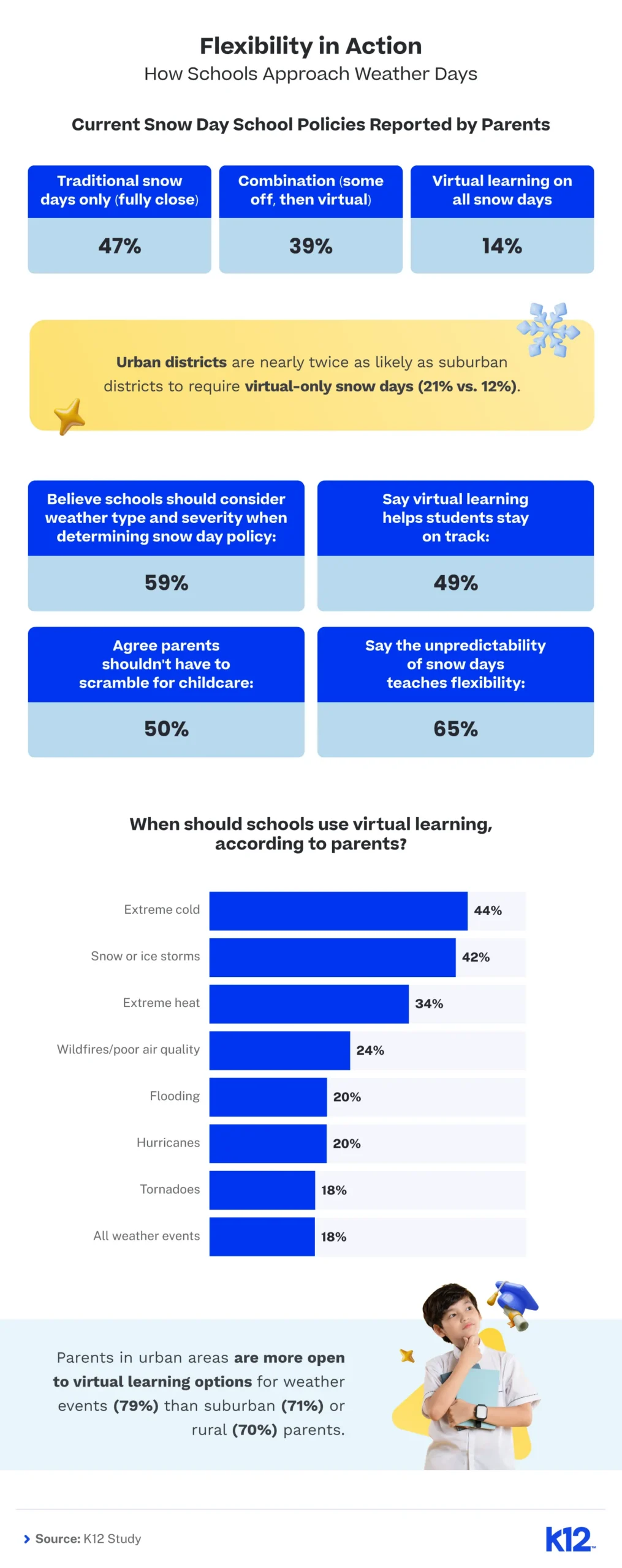
- 47% of districts still take a fully traditional approach to snow days (school closed, no assignments).
- 39% of districts now offer a combination of traditional days and virtual options.
- 14% of districts have moved to virtual learning for all snow days.
- Urban districts are nearly twice as likely as suburban districts to offer virtual-only snow days (21% vs. 12%).
- 59% of parents believe schools should consider the type and severity of the weather when deciding on snow day actions.
- 65% agree that the unpredictability of snow days teaches children to be flexible.
- 49% of parents say virtual learning on snow days helps students stay on track academically.
- 50% agree parents shouldn’t have to scramble for childcare due to unexpected closures.
- When Parents Support Virtual Learning:
- Extreme cold: 44%
- Snow or ice storms: 42%
- Extreme heat: 34%
- Wildfires/poor air quality: 24%
- Flooding: 20%
- Hurricanes: 20%
- Tornadoes: 18%
- All weather events: 18%
- Parents in urban areas are more open to virtual learning options for weather events (79%) than suburban (71%) or rural (70%) parents.
Preserving Snow Days Without the Disruption
The message from parents is clear: snow days matter, and they’re worth protecting. But families also recognize that extended closures can create challenges.
Furthermore, not all snow days allow for fun. Extreme cold or blizzard conditions have all the disruption of a traditional snow day, but without the play. The solution isn’t to eliminate snow days, it’s to find the right balance and use online learning to remove the disruption caused by severe weather. And in the end, parents agree.
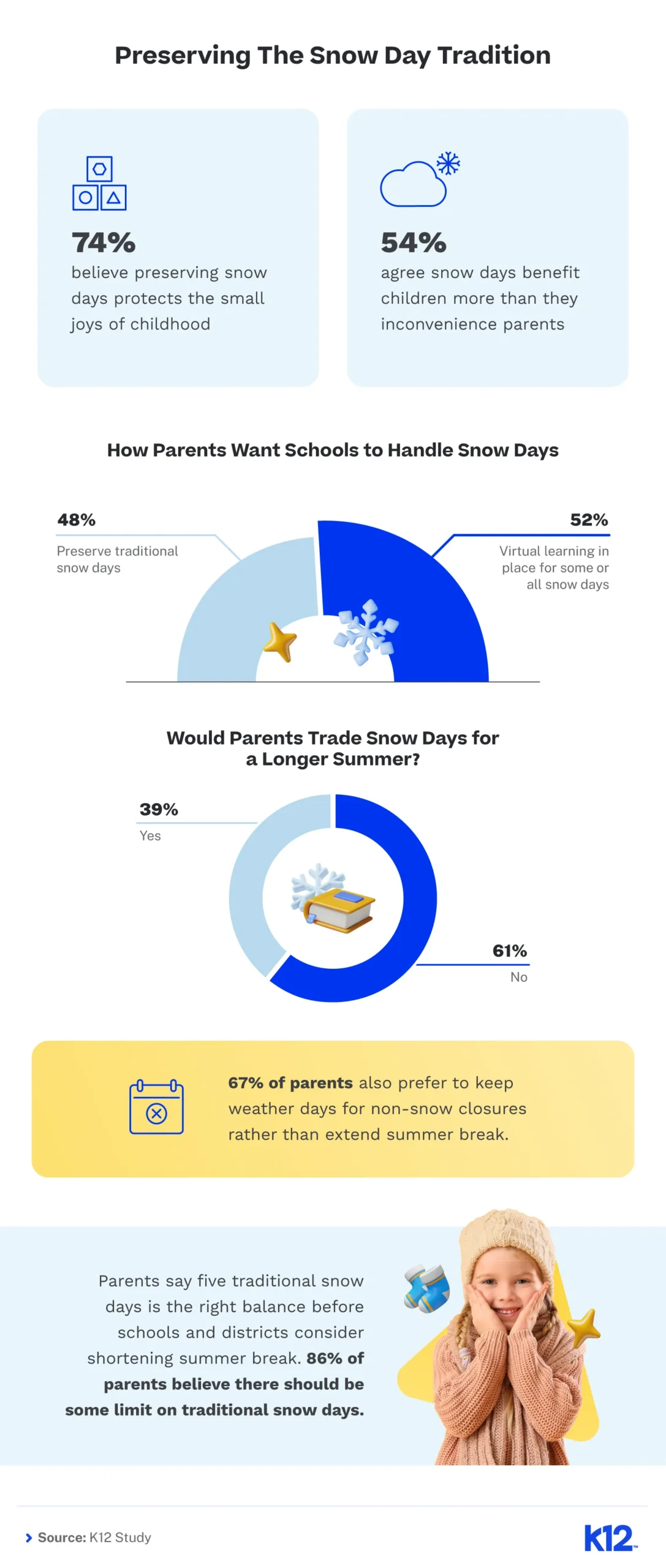
- 74% of parents believe preserving snow days protects the small joys of childhood.
- 54% agree that snow days benefit children more than they inconvenience parents.
- Still, more than 1 in 2 parents (52%) want virtual learning in place for some or all snow days.
- 41% of parents want to balance traditional snow days with virtual options.
- 11% of parents want virtual learning on all snow days.
- 86% of parents believe there should be some limit on traditional snow days.
- Parents say five traditional snow days is the right balance before schools and districts consider shortening summer break.
- 61% of parents prefer to keep snow days rather than trade them for a longer summer break.
- 67% feel the same way about other weather-related closures.
Methodology
For this study, we used NWEA data to examine how different states handle virtual learning days during severe weather events. Additionally, we surveyed 1,004 parents who were not affiliated with K12 to understand their perspectives on snow days, virtual learning, and how they want their children’s education handled.
Fair Use Statement
The information in this article may be used for noncommercial purposes only. If shared, please provide proper attribution and include a link back to K12.com.