
 About Us
 Why K12?
 Safety Needs
 How Students Succeed
 FAQs
FAQs Online Elementary School
 Online Middle School
 Career and College Prep
 Online High School
 Student Clubs
 Career and College Services
 Inside the Online Classroom
 A Day in the Life
 Social & Extracurricular
 Advice, Tips & Inspiration
 Benefits for Life
 Enroll
 All School Options
 Need More Help?
For many families, music has become part of the rhythm of homework and study time. Whether it’s a favorite playlist in the background or soft sounds that help block out distractions, music often plays a quiet but meaningful role in how students learn at home.
To better understand how families are using music during study time, we surveyed more than 1,000 parents with school-aged children across the U.S. Parents shared how often their children study with music, what they listen to, and how music affects factors like focus, stress, and academic performance. All insights in this article come from our survey, and no respondents were affiliated with K12.
Key Takeaways
- Parents say Taylor Swift is the most popular study-time artist, followed by Morgan Wallen and Drake.
- 40% of parents say their child performs better academically when they study with music.
- Pop is the most common study genre (51%), followed by rock (27%) and hip-hop (26%).
- 48% of parents of high-performing students say their child regularly studies with music, compared to 30% of parents whose children are falling behind.
- The most common benefit parents see from study music is reduced stress or anxiety (50%).
- More than one in 10 top-performing students (14%) listen to music with their parents while studying.
How Music Fits Into Study Habits
Study routines don’t look the same for every student. Between busy schedules, different learning styles, and more flexibility in where and how schoolwork happens, families often experiment with what helps their child focus — and music is a common option.
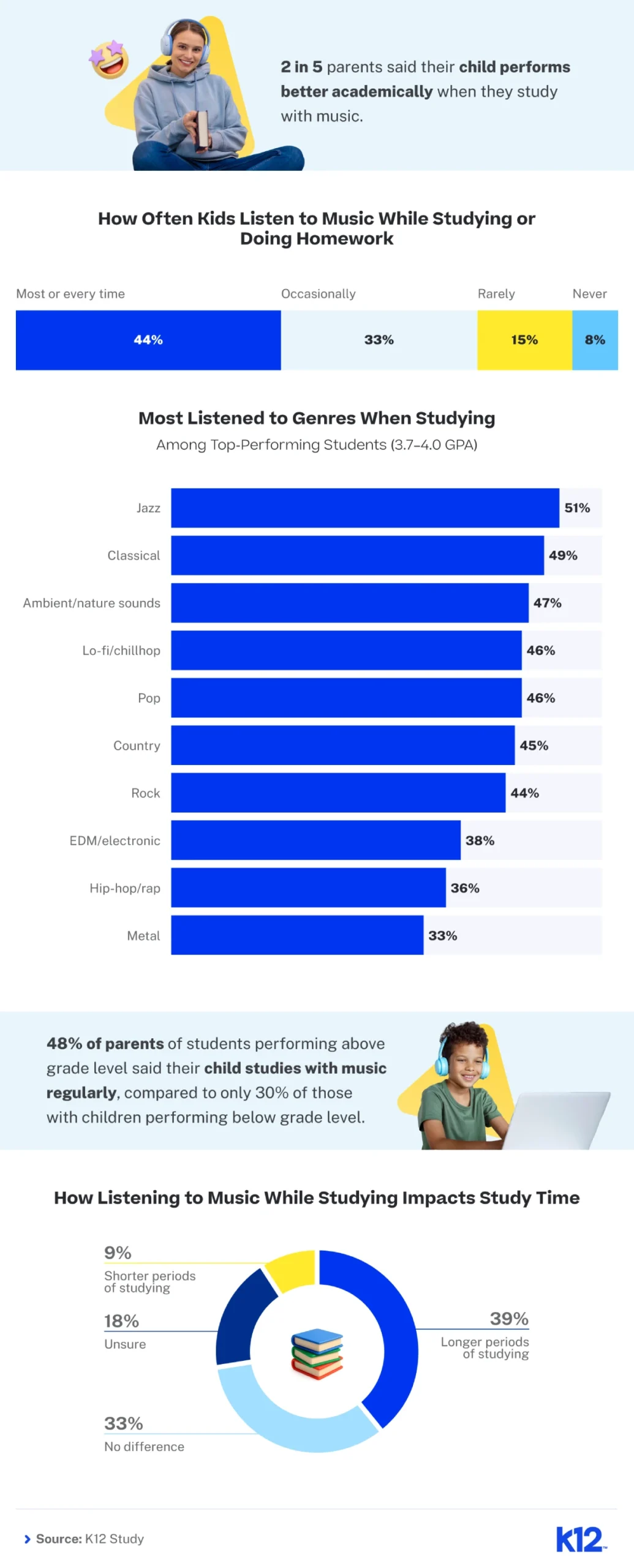
Listening to music while studying is already part of daily life for many students. More than three in four parents (77%) said their child studies with music at least sometimes. That includes 44% who said their child listens most or every time they study, and 33% who said it happens occasionally. Only 15% said their child rarely studies with music.
Parents of higher-achieving students were more likely to say music is part of their child’s routine. Nearly half (48%) of parents with students performing above grade level said their child regularly studies with music, compared to 30% of parents with students performing below grade level.
Many parents also noticed academic benefits. Two in five said their child performs better academically when music is part of study time. Parents were more likely to say music helped their child study longer (39%) than shortened study time (9%).
What Students Are Listening to While They Study
As students spend more time studying independently, they often choose their own playlists, giving parents a clearer picture of what actually helps their child concentrate.
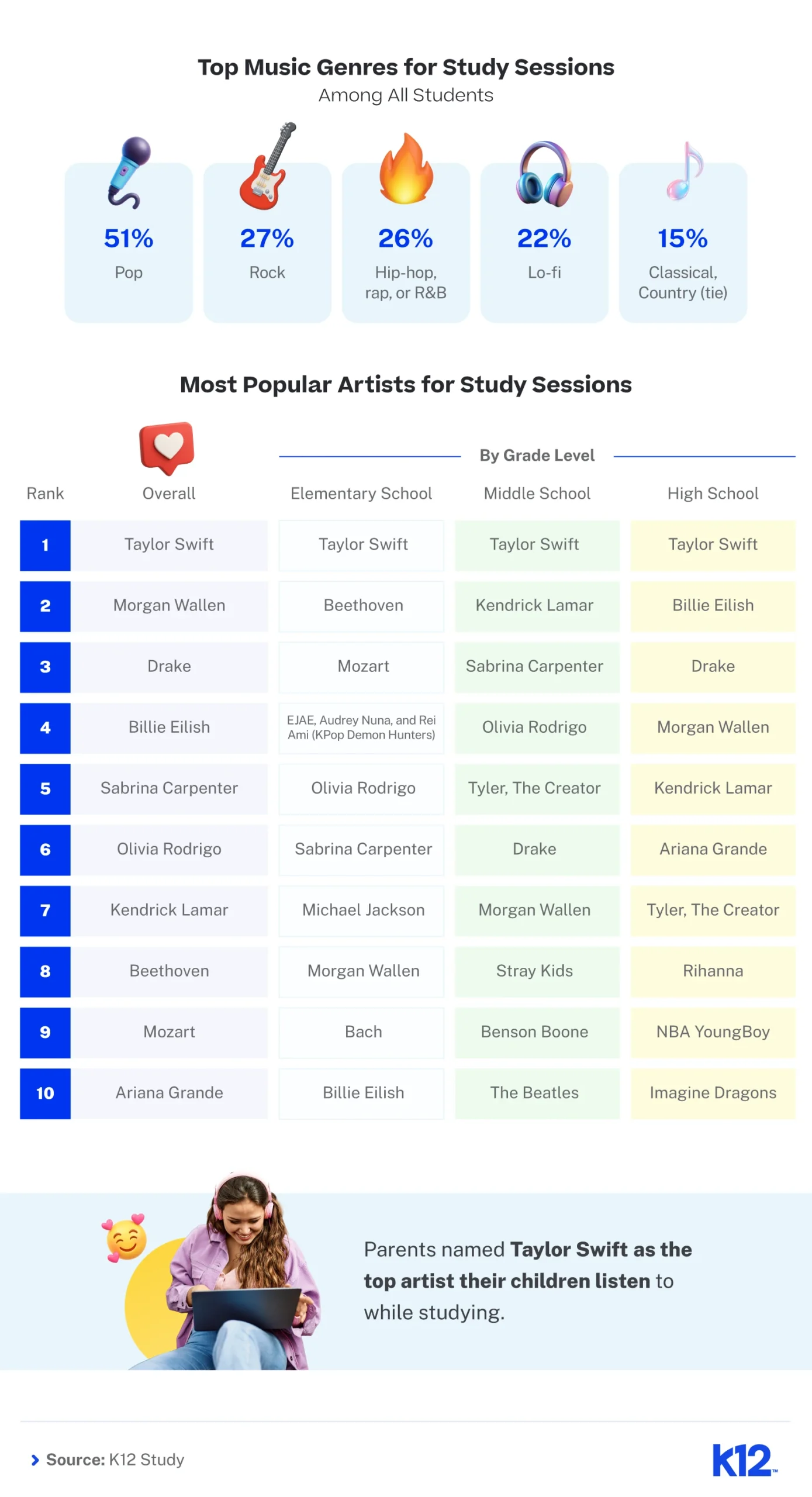
Pop music topped the list, with 51% of parents saying their child listens to it while studying. Rock followed at 27%, with hip-hop, rap, and R&B close behind at 26%. Preferences varied by age: middle and high school students were more likely to choose hip-hop, rap, and R&B, while classical music appeared most often among elementary students.
Across all age groups, Taylor Swift stood out as the most popular artist. She accounted for 22% of write-in responses and ranked No. 1 overall. Morgan Wallen placed second and was the only country artist to appear in the top 10 across every grade level. Drake ranked third and was especially popular with older students.
Top 3 Artists Students Listen to While Studying, by Genre
Ambient/Nature sounds
- Calmsound
- Owl Moon
- Thunder Sounds
Classical
- Beethoven
- Mozart
- Bach
Country
- Morgan Wallen
- Jelly Roll
- Luke Combs
EDM/Electronic
- Gorillaz
- Tame Impala
- Marshmello
Hip-Hop/Rap
- Drake
- Kendrick Lamar
- Tyler, The Creator
Jazz
- Laufey
- Miles Davis
- Frank Sinatra
Lo-Fi/Chill-Hop
- Lo-fi Girl
- C418
- Lofi Beats
Metal
- Metallica
- Deftones
- Five Finger Death Punch
Pop
- Taylor Swift
- EJAE, Audrey Nuna, and Rei Ami (KPop Demon Hunters)
- Billie Eilish
Rock
- Imagine Dragons
- Fall Out Boy
- Queen
How Music Affects Students’ Mindset
Beyond study habits and academic outcomes, parents also shared how music affects their child’s mindset during study time, including its role in managing stress and staying motivated.
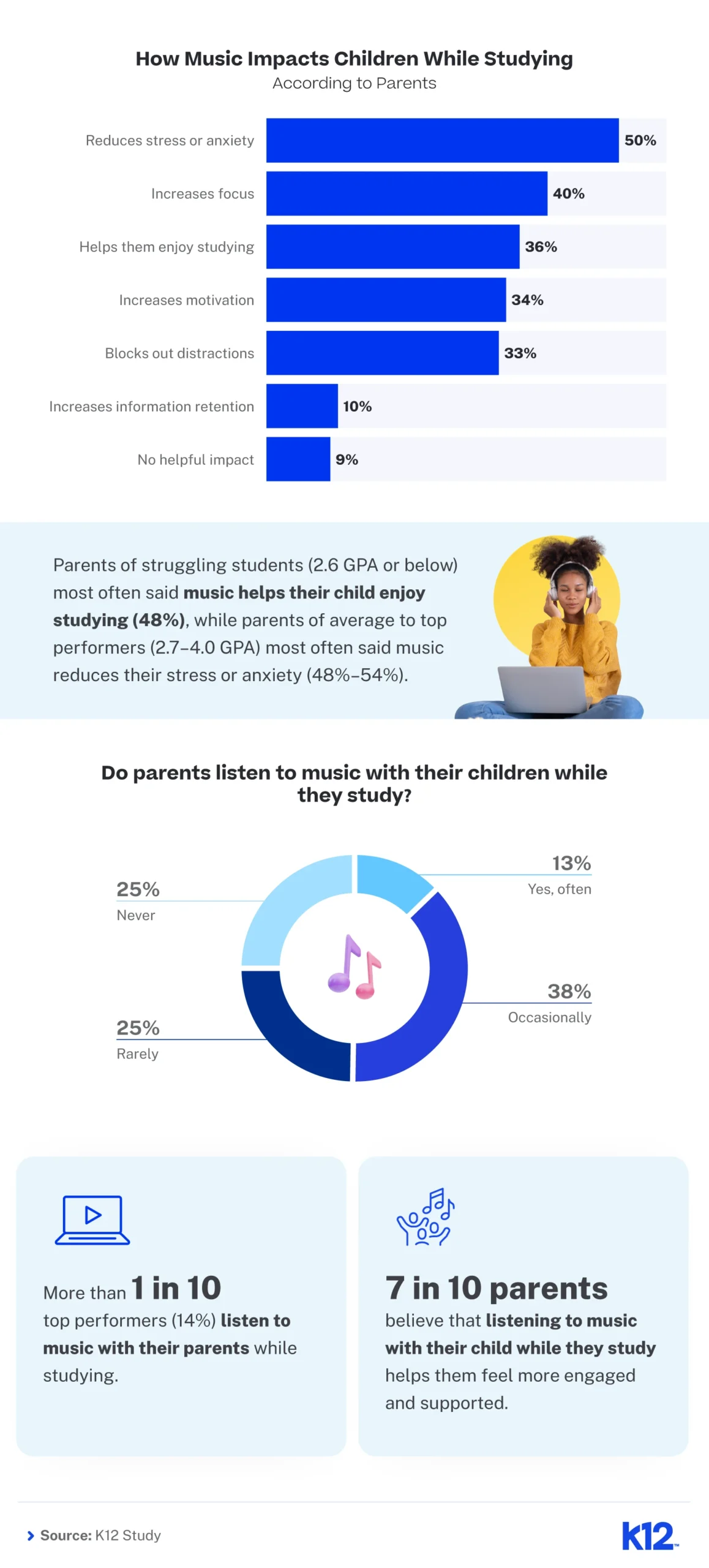
Reducing stress or anxiety was the most common benefit parents associated with study music, cited by 50% overall. Parents also said music helped their child focus (40%), enjoy studying more (36%), stay motivated (34%), and block out distractions (33%).
Parents of struggling students were most likely to say music helped their child enjoy studying (43%). Parents of average to top-performing students were most likely to say music helped reduce stress, with responses ranging from 48% to 54%.
Music also created moments of connection. While 13% of parents said they often listen to music with their child during study time, another 38% said they do so occasionally. More than 1 in 10 top-performing students (14%) listened to music alongside a parent, and 70% of parents said sharing music during study time helped their child feel more engaged and supported.
Finding What Works for Your Child
Music shows up in study time in different ways for every family. In the K12 survey, many parents shared that the right background sound helped their child feel calmer, stay focused, or simply feel better about sitting down to work. While there is no one right approach, these insights suggest that paying attention to what helps your child feel comfortable can make study time easier and more positive. Sometimes, small adjustments like music can help learning feel a little less overwhelming and a lot more manageable.
Methodology
This survey included 1,006 parents in the United States with children ages 5 to 18. Respondents were not affiliated with K12. The survey explored how often students listen to music while studying, which genres and artists they prefer, and how parents perceive music’s impact on focus, motivation, stress, and academic performance. Parents were also asked about their child’s grade level and academic standing to identify potential correlations between music habits and GPA.
Among respondents, 64% identified as women, 35% as men, and 1% as nonbinary. Generationally, 2% were Baby Boomers, 32% were Gen X, 62% were Millennials, and 4% were Gen Z. In terms of their children’s grade level, 31% had children in elementary school, 29% in middle school, and 40% in high school.
Regarding academic performance, 45% reported having top-performing students (3.7–4.0 GPA), 34% had above-average students (3.3–3.6 GPA), 10% had average students (2.7–3.2 GPA), and 2% had struggling students (2.6 GPA or below). Another 9% did not know their child’s GPA and were excluded from GPA-based comparisons. Data was collected in November 2025.
Fair Use Statement
The information in this article may be used for noncommercial purposes only. If shared or referenced, proper attribution with a link back to K12 must be included.