
 About Us
 Why K12?
 Safety Needs
 How Students Succeed
 FAQs
FAQs Online Elementary School
 Online Middle School
 Career and College Prep
 Online High School
 Student Clubs
 Career and College Services
 Inside the Online Classroom
 A Day in the Life
 Social & Extracurricular
 Advice, Tips & Inspiration
 Benefits for Life
 Enroll
 All School Options
 Need More Help?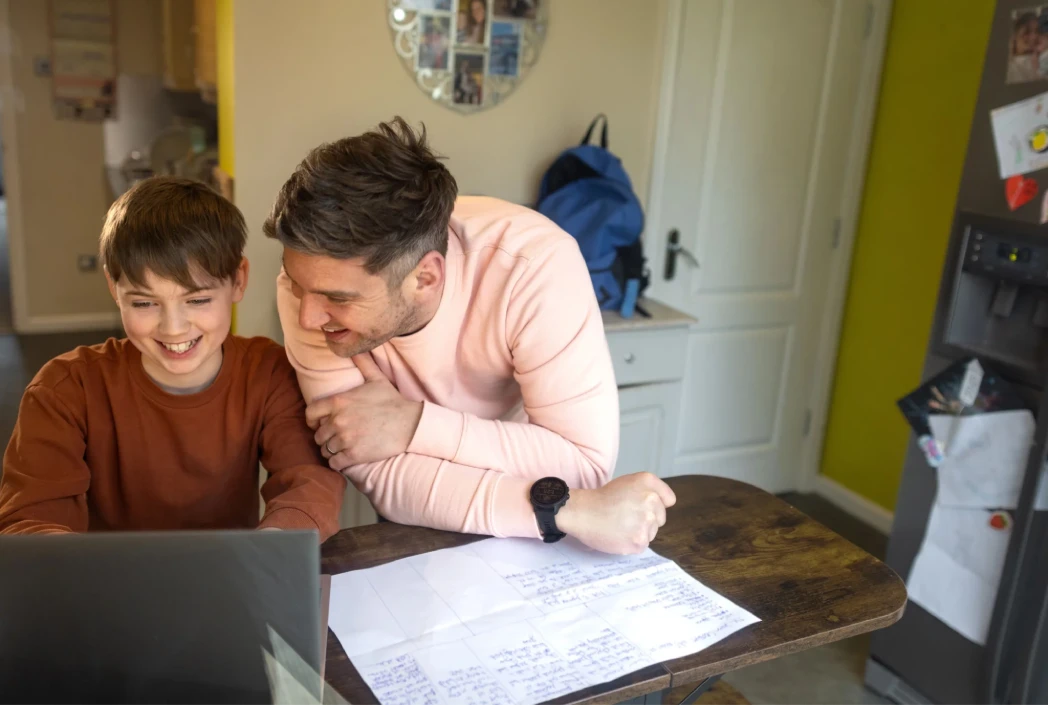
Back-to-school routines work best as a connected system rather than three separate schedules. What happens at bedtime shapes how the morning goes. What happens in the morning shapes how a child handles school and homework. And what happens after school shapes how easily bedtime comes together that night. Building routines with that connection in mind — rather than fixing mornings, homework, and bedtime as isolated problems — is what actually reduces the daily friction most families feel this time of year.
Create a Morning Routine

Mornings tend to go wrong for the same reason every year: too many decisions happening at once, under time pressure. A few structural fixes solve most of it.
Shift wake times gradually, not all at once. Summer schedules and school schedules are often 2 or 3 hours apart. Moving in small increments — 10 to 15 minutes earlier every couple of nights — gives a child’s body time to catch up, instead of forcing an abrupt reset that leaves them groggy on day one.
Give backpacks, shoes, and jackets one home. A single spot by the door — a bin, a hook row, a bench — eliminates the “where’s my other shoe” scramble that eats up 5 minutes every single morning.
Turn the routine into something a child can see, not just hear. A simple picture checklist works better than verbal reminders for younger kids, because it doesn’t require a parent to repeat instructions. And when a task gets checked off, naming exactly what they did well — “you got dressed all by yourself” instead of a generic “good job” — tends to stick better and makes them more likely to do it independently again tomorrow.
One habit that doesn’t get talked about enough: parents getting up before their kids. Even 10 quiet minutes to get yourself oriented before the house wakes up changes the whole tone of the morning — there’s a real difference between reacting to chaos and staying a step ahead of it.
Streamline the Evening Reset
Most morning stress is actually evening prep that didn’t happen. Two things make the biggest difference.
Move tomorrow’s decisions to tonight. Picking out clothes, packing lunch, signing whatever needs signing — none of it has to happen at 7 AM. Doing it the night before doesn’t just save time; it removes decisions from a part of the day when everyone has the least patience for them.
Give screens a firm cutoff. Devices off — and ideally out of the bedroom entirely — 30 to 60 minutes before lights out. The stimulation from a screen right before bed makes it genuinely harder for a child’s brain to downshift into sleep mode, regardless of how tired they seem.
Sleep is where the research is most conclusive, and it’s worth taking seriously: school-age kids need 9 to 11 hours a night, teens need 8 to 10, and both do best with the same bedtime and wake time every day of the week — weekends included. The specific activities in a wind-down routine matter less than the fact that they happen in the same order every night. A predictable sequence, whatever it includes, becomes the signal that tells a child’s body it’s time to sleep.
Establish Healthy Homework Habits

Homework battles are rarely about the homework itself — they’re usually about timing and environment.
Set up one consistent spot for schoolwork. It doesn’t need to be fancy. A quiet corner with the basics — pencils, paper, a calculator — beats a rotating location every day, because kids stop wasting energy figuring out where and how to start.
Don’t skip the reset before homework starts. After 6 or 7 hours of structured school, most kids need a genuine break before tackling more work — a snack, some outdoor time, anything that isn’t a screen. Pushing straight into homework right after the bus drops off usually backfires and takes longer overall than if you’d built in 20 minutes of downtime first.
From there, a steady daily homework window with short breaks built in tends to outperform a single long, uninterrupted session. And for families where a parent is doing more hands-on academic support — which is common for K12-powered students working with a Learning Coach — those same short breaks matter for the adult’s focus, not just the child’s.
Build Independence and Confidence
Practice the small stuff before it matters. Unzipping a backpack, opening a tricky lunch container, managing a zipper — rehearsing these at home means a child isn’t figuring them out for the first time in front of classmates.
Independence tends to grow fastest when kids get some real say in their own routine, not just choices that are choices only in name. Let a younger child help build a picture schedule by picking out the images themselves. Let an older child actually weigh in on bedtime and hear the reasoning behind it, rather than just being told what it is.
It’s also worth noting that a new routine feels unsettling at first — for kids and often for parents too. Saying that out loud, rather than focusing only on logistics, tends to make the adjustment easier than pretending it’s not a big deal.
Why These Routines Work as One System
Here’s the part that’s easy to miss: Morning, after-school, and bedtime routines aren’t three separate problems to solve — they’re a loop, and each one feeds into the next. Good sleep leads to an easier morning, an easier morning sets up a better school day, and a better school day means less depletion by afternoon, which makes homework and bedtime go more smoothly. That loop runs in reverse too: a late night creates a rough morning, a rough morning follows a child into school as stress, and a hard day leaves them running on empty by the time homework and bedtime roll around — starting the cycle over again.
The practical upside of thinking about it this way: You don’t need to overhaul all three routines simultaneously. Fix whichever one is causing your family the most pain right now, and the other two often start improving on their own.
When to Begin Practicing Routine
Two to three weeks out is the sweet spot — shift sleep times gradually (15-minute increments work better than one abrupt change) and run a full dress rehearsal during the final week, even with nowhere to go. It’s usually where the real snags show up, like the backpack nobody can find.
What “involved” looks like should shift with age: younger kids do better with visual schedules and a parent coaching each step, while middle schoolers do better handling more of the sequence themselves, with an actual conversation about the reasoning behind bedtime rather than just an announcement.
What to do if your child isn’t responding well to the back-to-school routine?
If a child is pushing back on a routine, it’s often worth going back to how it was built rather than pushing harder on enforcement. Ask what they’d want different, explain the reasoning behind a piece they’re resisting, and build in one real choice — pushback tends to soften once a kid has some actual input.
If the whole system feels like too much, strip it down to sleep, meals, and the basics of getting ready. Everything else — chore charts, elaborate checklists — can wait until the core routine feels solid.
When illness, travel, or a rough stretch knocks things off course, that’s not a routine failing — it’s normal. A scaled-back version for a few days, then a gradual return to the full routine, works better than trying to snap back to 100% overnight.
Building Routines That Work for Your Family
The families who handle back-to-school most smoothly aren’t running the most complicated system — they’re running the one that actually fits how their household works. Pick whichever routine is causing the most friction right now and start there.
That kind of flexibility matters even more when school doesn’t follow a traditional shape. For families learning through a K12-powered school, the line between “school routine” and “home routine” is less clear-cut by design — which makes a steady structure just as important, arguably more so, than it is for a family walking out the door to a traditional classroom each morning.