 About Us
 Why K12?
 Safety Needs
 How Students Succeed
 FAQs
FAQs Online Elementary School
 Online Middle School
 Career and College Prep
 Online High School
 Student Clubs
 Career and College Services
 Inside the Online Classroom
 A Day in the Life
 Social & Extracurricular
 Advice, Tips & Inspiration
 Benefits for Life
 Enroll
 All School Options
 Need More Help?
K12 Game On Competition 2026: Launch Your Student’s Journey in Educational Game Design
Find the 2026 K12 Game On Competition! Learn how to explore educational game design, develop STEM skills, and compete in this exciting opportunity.
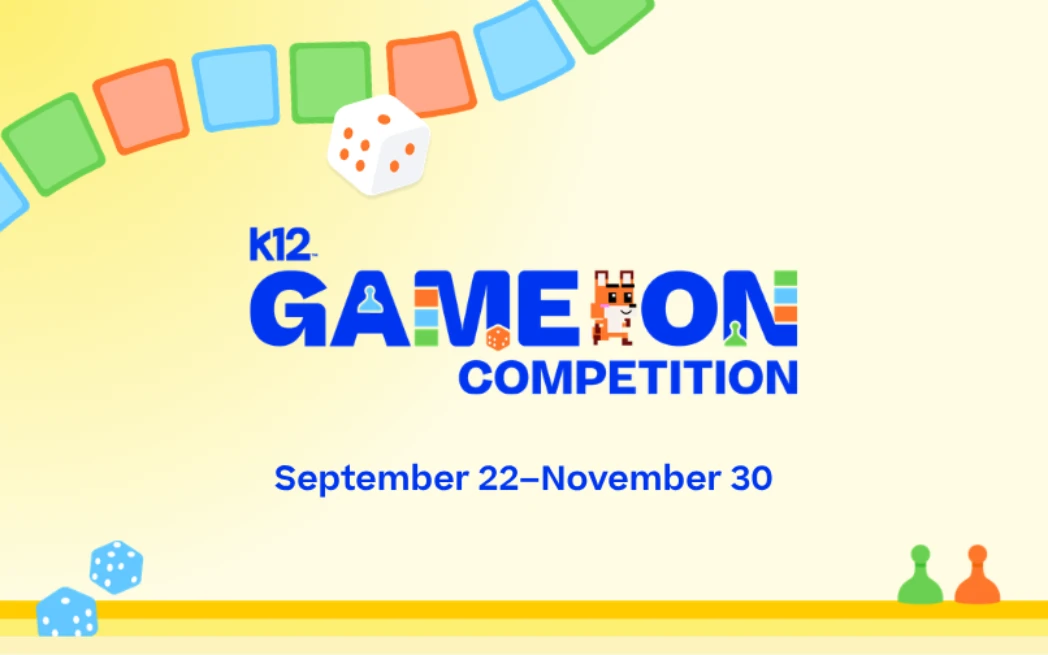
Table of Contents
The 2026 K12 Game On competition invites students in grades K–12 to design educational video games and compete for exciting prizes. This nationwide competition provides an opportunity for young creators to showcase their creativity while developing valuable STEM skills. Students enrolled in K12-powered schools can join in this multi-round challenge that turns game ideas into polished presentations.
Whether your child dreams of becoming a game designer or simply loves gaming, this competition offers a structured pathway to explore educational game design. Students compete within their grade band, ensuring fair evaluation against peers at similar developmental levels.
What is the K12 Game On competition?
The K12 Game On competition is a nationwide game design challenge created specifically for students in K12-powered schools. The competition provides students with an opportunity to showcase their creativity and understanding of educational game design while competing for significant prizes. This year, students can expand their thinking to include concepts for physical games, like board games or yard games, as well as digital games.
The competition divides participants into four grade bands: K–2nd grade, 3–5th grade, 6–8th grade, and 9–12th grade. Each division has two winners — one selected by official judges, and one People’s Choice winner determined through public voting.
Competition Structure:
- Round 1: Students submit a pitch for their educational game idea
- Round 2: Qualifying students submit a full proposal using a provided template
- Round 3: Finalists create game trailers using suggested tools to create their video demos or game trailers
The 2026 timeline is as follows:
- Registration open: September 22–November 30, 2026
- Public voting open: February 19–March 10, 2027
- Winners announced: April 2027 (TBD)
For students aged 13 and under, parents or guardians must submit entries on their behalf to ensure appropriate supervision and compliance with online safety regulations.
The Benefits of Educational Game Design for K–12 Students
Creating games offers students far more than entertainment — it builds critical skills that support academic success and future career opportunities. When students design games, they engage multiple disciplines at once while developing problem-solving abilities that transfer across subjects.
STEM Skills Development Through Game Creation
Game design serves as a powerful pathway to STEM learning. Students use mathematics for game mechanics, apply scientific principles for simulations, leverage technology for programming, and employ engineering design processes for problem-solving.
Research shows that game-based STEM learning produces significant educational benefits. Students who create games engage in computational thinking, including decomposition, pattern recognition, abstraction, and algorithm design. These skills represent a new paradigm in problem-solving that prepares students for technology-driven careers.
Visual programming environments like Scratch make coding accessible by letting students drag and assemble code blocks rather than write text-based code. This approach helps students understand programming logic without getting overwhelmed by syntax errors. As students advance, they naturally transition to platforms that introduce real programming languages in beginner-friendly ways.
How to Get Your Student Started in Game Design
Getting started in game design has never been more accessible. Free, high-quality platforms are available for every age group, making it easy for students to start creating right away.
Beginner-Friendly Tools by Age Group:
- Elementary School (Ages 6–10): Scratch offers colorful block-based coding perfect for beginners. Students create 2D games using drag-and-drop interfaces without typing any code. Kodu Game Lab provides 3D game design with simple when/do commands.
- Middle School (Ages 10–14): Roblox Studio teaches Lua programming through game creation. Students can start with templates and gradually add complexity. GDevelop offers point-and-click game design with optional JavaScript extensions.
- High School (Ages 13+): Unity provides professional-grade tools with C# scripting. Godot offers open-source game development with Python-like scripting. Both support 2D and 3D games with extensive documentation.
Parent Guidance Tips:
- Start with small, achievable projects to build confidence
- Learn alongside your child — you don’t need to be an expert
- Provide structured time for game design work
- Encourage problem-solving over immediate solutions
- Connect projects to your child’s interests
- Celebrate progress, even when projects are simple or buggy
K12-powered schools provide resources and support for students interested in game design. Teachers can guide students through the learning process, and many schools offer coding clubs or game design courses that prepare students for competitions like K12 Game On.
Judging Criteria and Prizes:
Judges evaluate entries on creativity, educational value, design quality, and feasibility. Final winners from each of the four grade bands will receive a prize of $100, and one People’s Choice winner from each grade band will receive a $50 prize. In addition, one raffle winner will be selected at random to receive a $100 cash prize. Prizes can be redeemed as cash or a Tango e-gift card.
Beyond prizes, participants gain valuable experience in design thinking, project management, and creative expression. Competition participation provides portfolio pieces and recognition that support college applications and future opportunities.
Empowering Student Creativity Through Game Design
The 2026 K12 Game On competition offers students an exciting opportunity to explore educational game design while developing skills that extend far beyond gaming. Through this competition, students learn problem-solving, critical thinking, and creative expression in a supportive environment.
Whether your child is an experienced coder or completely new to game design, this competition provides a structured pathway to showcase their creativity. With resources, support, and clear guidelines, students can transform their game ideas into polished presentations that demonstrate their unique vision.
As you consider opportunities for your child’s learning and growth, exploring game design through competitions like K12 Game On can open doors to new interests and capabilities. The skills students develop — from computational thinking to creative problem-solving — prepare them for success in an increasingly technology-driven world.